


Salesforce: The right information system that meets business needs will require to increase sales of a company’s products or services. One sort of management information system that is presently in use is SalesForce Automation. This time, read our post to understand more about SalesForce.
The sales force of an industry comprises divisions, teams, or individuals responsible for selling products and services. As part of everyday operations, clients and potential customers will visit or phoned regularly. As a result, the central role of this position is to create a sales plan and manage technology to increase product or service sales and produce income for the organization.
Table of Contents
What Exactly Is Salesforce in 2026?
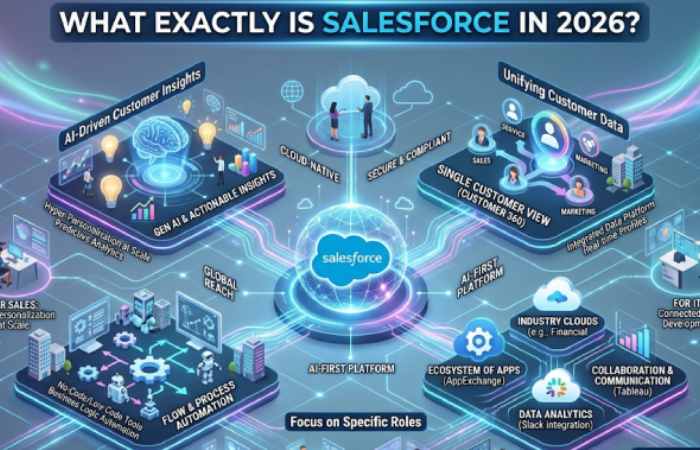
Salesforce started in 1999 as the very first cloud-based CRM. Fast forward to today and it’s a massive ecosystem that includes Sales Cloud, Service Cloud, Marketing Cloud, Commerce Cloud, Tableau, Slack, MuleSoft, and a whole AI layer called Einstein.
Most people still think “Salesforce = CRM,” but that’s like saying “iPhone = phone.” It’s way bigger now.
| Aspect | Explanation (2026 Perspective) |
| What is Salesforce? | Salesforce is an AI-powered, cloud-based customer platform that helps businesses manage sales, marketing, service, commerce, and data from one unified system. |
| Core Purpose | To centralize customer data and automate customer interactions across the entire lifecycle. |
| Platform Type | Customer Relationship Management (CRM) + AI + Data Platform |
| Primary Users | Sales teams, marketers, customer support, e-commerce teams, analysts, and executives |
| Key Technology | Einstein AI, Data Cloud, Automation (Flow), low-code tools |
| Main Products | Sales Cloud, Service Cloud, Marketing Cloud, Commerce Cloud, Experience Cloud |
| AI Capabilities | Predictive lead scoring, personalized journeys, AI copilots, automated insights |
| Data Handling | Real-time customer data unification across apps and external sources |
| Automation Level | Advanced workflow automation across sales, service, and marketing |
| Customization | Highly customizable with low-code and pro-code development |
| Integration Power | Integrates with thousands of tools via MuleSoft and APIs |
| Analytics & Insights | Built-in dashboards, Tableau analytics, AI-driven forecasts |
| Security & Compliance | Enterprise-grade security, GDPR & industry compliance |
| Scalability | Designed for startups to global enterprises |
| Deployment Model | 100% cloud-based (SaaS) |
| Mobile Access | Full-featured mobile CRM apps |
| Ecosystem | Large marketplace (AppExchange) with 7,000+ apps |
| Industries Served | Retail, healthcare, finance, real estate, tech, education, manufacturing |
| How It’s Different in 2026 | Focuses on AI copilots, real-time data, personalization at scale |
| Business Value | Higher productivity, better customer experiences, data-driven growth |
In 2026, Salesforce is basically the operating system for customer-facing teams. Everything lives in one place: leads, opportunities, customer cases, marketing campaigns, chatbots, analytics — even your Slack messages if you want.
Why Companies Still Choose Salesforce (Even When It’s Expensive)
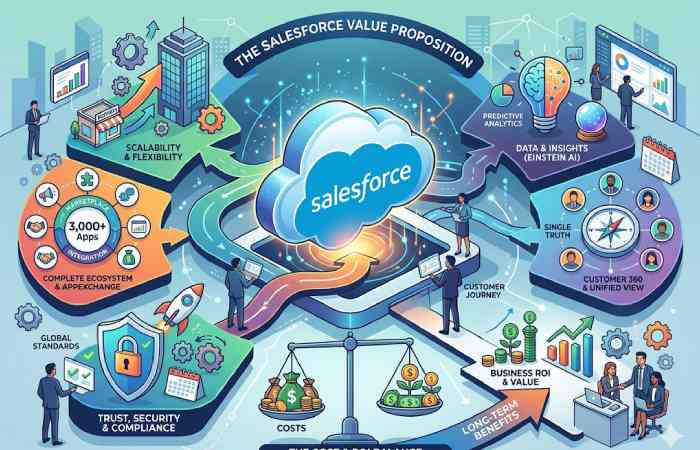
I get asked this all the time: “Why not just use HubSpot or Zoho?” Here’s the honest answer from someone who’s migrated companies off and onto Salesforce:
- It scales like nothing else. I’ve seen companies go from 5 reps to 5,000 reps without changing platforms.
- The AppExchange is insane. 7,000+ ready-made apps and components. Need CPQ? Billing? Contract management? Field service routing? It’s already built by someone.
- Einstein AI actually works now. Predictive lead scoring, email content suggestions, and next-best-action recommendations are no longer gimmicks.
- Data lives forever (mostly). Once you’re in, switching costs are brutal — which is terrible for leaving, but great for long-term planning.
Salesforce Pricing Breakdown (2026 – Real Numbers)
| Plan / Edition | Price (USD / user / month) | Who It’s For | What’s Included (Core) |
| Free Suite | $0 | Very small teams / trials | Basic CRM: leads, contacts, accounts; Slack integration (2 users) |
| Starter Suite | $25 | Small businesses & startups | Core CRM + sales flows, lead routing, basic email marketing, analytics |
| Pro Suite | $100 | Growing teams needing customization | Everything in Starter + automation, forecasting, AppExchange access |
| Enterprise | $175 | Mid-sized to large orgs | Advanced pipelines, deal insights, APIs, conversation intelligence |
| Unlimited | $350 | Enterprise with full support | Enterprise + predictive AI, premier support, full sandbox |
| Agentforce (Einstein 1 Sales) | $550+ | AI-driven enterprise CRM | Unlimited AI usage, Salesforce Maps, analytics, advanced AI tools |
How Costs Add Up in Practice
| Component | Typical Additional Cost | Notes |
| Implementation/Setup | ~30–35% of license cost | Many businesses incur this extra cost for configuration, data migration, and training. |
| Premium Support (Premier Success Plan) | ~30% of license fees | Optional accelerated support with 24/7 access. |
| Add-Ons (e.g., Revenue Intelligence) | $220+ / user / month | Extra analytics and insights tooling may require separate fees. |
| CPQ, Slack, Tableau, etc. | Varies widely | Many orgs bundle these and pay additional millions annually at enterprise scale (community feedback). |
Example Real-World Costs
| Scenario | Typical Price Range |
| 10 users, Pro Suite | ~$1,000/month (~$12,000/year) |
| 50 users, Enterprise | ~$8,750/month (~$105,000/year) |
| 100 users, Unlimited | ~$35,000/month (~$420,000/year) |
| Large org with add-ons | $500K+ / year |
The Primary Distinction Between Salesforce And CRM
There are several sorts of management information systems and how they may utilize to improve the business quality. CRM and SalesForce are two examples of management information system products (MIS). However, there are some significant variations between the two SIMs.
CRM is a contraction for customer relationship management, and it is a scheme that enables businesses to manage their relationships and interactions with present and prospective consumers.
On the other hand, Salesforce wants to be able to automate and grow the business efficiently.
Salesforce Functions & Key Features
| Salesforce Function | What It Does | Key Features |
| Sales Cloud | Manages sales processes and pipelines | Lead & opportunity management, sales forecasting, contact & account tracking, automation workflows |
| Service Cloud | Handles customer support and service | Case management, omnichannel support, chat & bots, SLA tracking, knowledge base |
| Marketing Cloud | Automates and personalizes marketing | Email campaigns, customer journeys, SMS & WhatsApp marketing, AI-driven personalization |
| Commerce Cloud | Powers online buying experiences | B2B & B2C commerce, AI recommendations, order management, mobile-first storefronts |
| Experience Cloud | Builds customer & partner portals | Custom portals, self-service communities, branding customization, secure access |
| Data Cloud | Unifies customer data across sources | Real-time data ingestion, identity resolution, unified customer profiles |
| Analytics (Tableau CRM) | Provides insights and reporting | Interactive dashboards, predictive analytics, AI-powered insights |
| Einstein AI | Adds AI across Salesforce apps | Lead scoring, predictive forecasting, recommendation engine |
| Platform (Lightning Platform) | Custom app development | Low-code tools, Apex & Lightning components, automation |
| Automation (Flow) | Automates business processes | Drag-and-drop flows, approvals, triggers, workflow rules |
| Integration (MuleSoft) | Connects systems and apps | API-led connectivity, data integration, automation |
| Collaboration (Slack Integration) | Improves team communication | Real-time alerts, deal collaboration, workflow approvals |
| Security & Compliance | Protects data and access | Role-based access, encryption, audit trails, compliance controls |
| AppExchange | Extends Salesforce capabilities | 7,000+ apps, partner solutions, easy installation |
| Mobile CRM | Access Salesforce on mobile devices | Mobile dashboards, offline access, real-time updates |
Salesforce Accountabilities
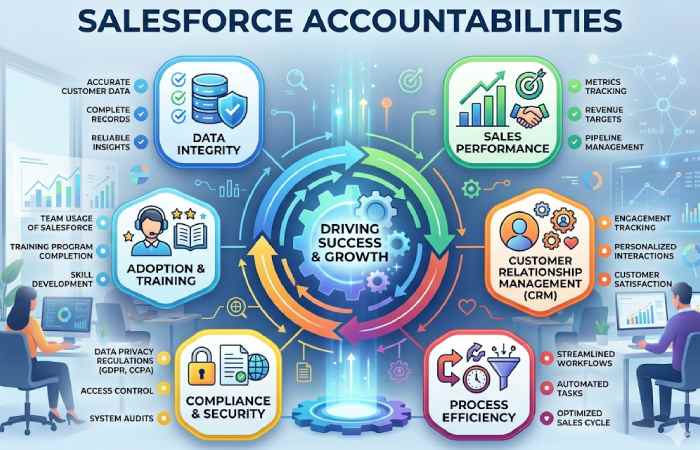
The primary purpose and obligation of SalesForce are to sell things or services as effectively as possible. Whereas sales and marketing professionals must comprehend and compute KPIs from business sales, SalesForce must also complete the following tasks and responsibilities.
1. Sales Marketing
Every person, or at least a percentage of them.In the sales department must advertise the items or services to potential customers. They must also make every attempt to get their products into the hands of potential purchasers.
2. Obtaining the Goal
Most businesses employ sales KPIs to assess target fulfillment, which will direct the income sector and the sales force’s performance. It also applies to the provision of rewards depending on the evaluation’s conclusions.
3. Communication With Consumers
Customers are one of the most significant factors in determining a company’s success. The first step in being a successful salesperson is to build excellent communication with consumers.
Salesforce vs HubSpot vs Zoho
| Aspect | Salesforce CRM | HubSpot CRM | Zoho CRM |
What It Is |
Enterprise-grade CRM platform with deep customization, automation, and AI capabilities. | CRM with strong sales and marketing tools, streamlined UX and powerful inbound features. | Value-focused CRM with broad automation, customization, and integrations. |
Typical Starting Price |
Starter Suite ≈ $25/user/mo (basic CRM) | Free plan available; Starter ≈ $15/user/mo | Free plan available; Standard ≈ $14–$20/user/mo |
Mid-Tier Pricing |
Pro Suite ≈ $100/user/mo | Professional tier ≈ $90–$100/user/mo | Professional ≈ $35/user/mo |
High-Tier Pricing |
Enterprise ≈ $165/user/mo, Unlimited ≈ $330/user/mo, Agentforce/AI ≈ $500+/user/mo | Enterprise ≈ $150/user/mo | Enterprise ≈ $50/user/mo, Ultimate ≈ $65/user/mo |
Free Plan |
Free 30-day trial (no perpetual free tier by default, but Free Suite may exist) | Yes — generous free CRM with core tools | Yes — free plan for up to ~3 users |
Ease of Use |
(Highly powerful but steeper learning curve) | (Best onboarding & UI) | (Customizable but UI can feel complex) |
Customization |
(Deep configuration & workflows) | (Good but less deep than Salesforce) | (High flexibility with Blueprints and modules) |
Sales Automation & Workflows |
Advanced automation, AI forecasting, and complex routing available. | Strong automation especially at Professional/Enterprise levels. | Broad automation included even at lower tiers. |
Marketing Tools |
Integrated when bundled (with additional cost) due to modular ecosystem. | Powerful marketing features integrated natively (email, lead scoring, automation). | Basic to advanced marketing features via bundle options; strong ecosystem integration. |
AI & Analytics |
Einstein AI; predictive forecasting; deep analytics (often add-ons). | AI tools for sales/marketing workflows, insights, reports. | Zia AI assistant with lead scoring and forecasting (tier dependent). |
Integrations |
Very extensive (AppExchange + native APIs). | Strong ecosystem; integrates well with web tools & marketing stacks. | Very good — integrates with many Zoho apps and 3rd-party tools. |
Best For |
Large enterprises, complex sales/service operations. | SMBs, marketing-led teams, companies needing strong inbound pipeline tools. | Budget-conscious SMBs and growing businesses needing value + flexibility. |
User Sentiment – Pros |
Highly customizable and scalable; robust analytics; enterprise support. | Easy to use; strong free tier; integrated marketing and sales; excellent onboarding. | Excellent value for money; integrates across suite; broad features at lower cost. |
User Sentiment – Cons |
Can be expensive; complexity requires training/admin. | Pricing jumps quickly with higher features; potential hidden costs. | UI can feel cluttered; some advanced tools limited to higher tiers. |
Salesforce Platform Country-wise Pricing Table
| Country | Currency | Starter Suite | Professional / Pro | Enterprise | Unlimited | Resource Link |
| India | USD (billed globally) | $25/user/month | $100/user/month | $175/user/month | $350/user/month | View India Pricing |
| United States | USD | $25/user/month | $100/user/month | $175/user/month | $350/user/month | View US Pricing |
| United Kingdom | GBP (£) | £20/user/month | £80/user/month | £140/user/month | £280/user/month | View UK Pricing |
| Europe (general) | EUR (€) | ~€25/user/month* | ~€100/user/month* | ~€175/user/month* | ~€350/user/month* | Explore EU Pricing |
| Australia | AUD ($) | ~A$38/user/month* | ~A$150/user/month* | ~A$260/user/month* | ~A$520/user/month* | Explore AU Pricing |
| Global (Standard List Price) | USD | $25 | $100 | $175 | $350 | Global Pricing Overview |
Last words
Salesforce in 2026 isn’t just a CRM anymore—it’s the backbone of how modern businesses understand customers, automate work, and scale intelligently. The real value doesn’t come from features alone, but from how well it’s aligned with your business goals, data strategy, and teams.
Related Post: Top Digital Marketing Software