
Steps to Creating a Brand Strategy
- Define Your Brand Purpose
Ask:
- Why does your brand exist?
- What problem do you solve?
- What impact do you want to make?
Outcome: Brand mission & vision
- Understand Your Target Audience
Research:
- Demographics (age, location, income)
- Psychographics (values, motivations, pain points)
- Buying behavior
Outcome: Clear customer personas
- Conduct Market & Competitor Research
Analyze:
- Competitors’ positioning
- Market gaps
- Industry trends
Outcome: Opportunities to differentiate
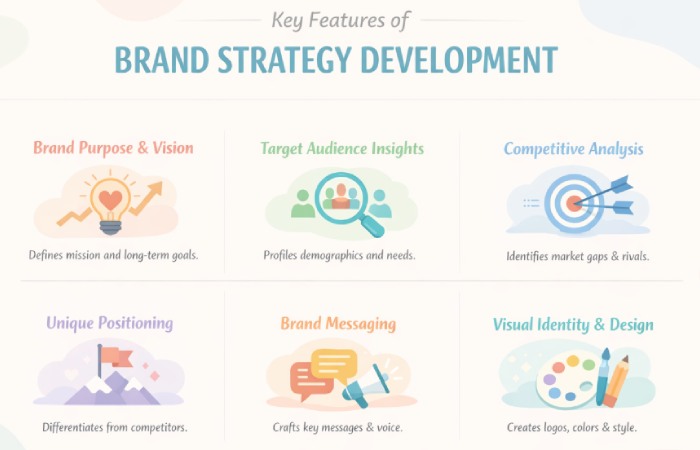
- Define Brand Positioning
This answers:
Why should customers choose you over others?
Includes:
- Unique value proposition
- Key differentiators
- Brand promise
Outcome: Strong positioning statement
- EstablishBrand Personality & Voice
Decide:
- Tone (professional, friendly, bold, playful, etc.)
- Personality traits (innovative, trustworthy, premium)
Outcome: Consistent brand voice across channels
- Create Messaging Framework
Develop:
- Core brand message
- Tagline
- Key benefit statements
- Proof points
Outcome: Unified communication
- Design Brand Identity (Visual Strategy)
Includes:
- Logo direction
- Color palette
- Typography
- Imagery style
Outcome: Visual consistency & recognition
- Build Brand Guidelines
Document:
- Voice & tone rules
- Logo usage
- Color and font rules
- Messaging examples
Outcome: A brand playbook everyone follows
- Implement & Activate the Brand
Apply strategy to:
- Website
- Social media
- Advertising
- Customer support
- Product experience
Outcome: Real-world brand presence
- Measure & Evolve
Track:
- Brand awareness
- Customer perception
- Engagement
- Loyalty
Outcome: Continuous improvement
Simple Brand Strategy Framework
| Element | Description |
| Purpose | Why the brand exists |
| Audience | Who the brand serves |
| Positioning | What makes it different |
| Personality | How it behaves |
| Messaging | What it says |
| Identity | How it looks |
| Experience | How it feels |
Brand Strategy Development — Country-wise Comparison
| Country / Region | Typical Pricing (Approx.) | Key Services Included | Best For | Resources / Links |
| United States | Freelancer: $1,500–$8,000 Agency: $8,000–$150,000+ |
Brand research, positioning, messaging, personas, guidelines, visual identity | Startups → Enterprises | • HubSpot Branding Guide • AMA Branding |
| India | Freelancer: ₹20,000–₹1,50,000 Agency: ₹1,50,000–₹30,00,000+ |
Brand audit, audience segmentation, positioning, strategy + execution planning | Startups, SMEs | • YourStory Branding Tips • HubSpot India |
| United Kingdom | Freelancer: £1,500–£7,000 Agency: £7,000–£80,000+ |
Market research, positioning, storytelling, visual identity, competitive analysis | UK SMEs, brands entering Europe | • Marketing Week Branding • The Drum Branding |
| Europe (EU) | Freelancer: €1,500–€8,000 Agency: €8,000–€120,000+ |
Brand strategy, messaging, personas, guidelines, cross-market positioning | EU brands, multi-market launches | • Brandwatch Insights • European Marketing Conf |
| Australia | Freelancer: AUD 2,000–AUD 10,000 Agency: AUD 10,000–AUD 100,000+ |
Strategic positioning, customer profiling, messaging frameworks | Local & APAC expansion | • SmartCompany Branding • Mumbrella |
| Canada | Freelancer: CAD 2,000–CAD 10,000 Agency: CAD 10,000–CAD 120,000+ |
Brand research, communications strategy, competitor maps | Startups → Mid-size brands | • Canadian Marketing Assoc • Strategy Magazine |
What’s Typically Included in Brand Strategy Development
| Component | Purpose |
| Brand Audit | Understand current positioning and perceptions |
| Market & Competitor Research | Gauge market gaps and competitive landscape |
| Audience Personas | Create detailed customer profiles |
| Brand Positioning | Develop unique value & differentiators |
| Messaging Framework | Define core brand messages and tone |
| Visual Identity Guidance | Logo, colors, typography direction |
| Brand Guidelines | A playbook for consistent use across platforms |
Typical Price Ranges Explained
United States
- Freelance Strategists: $1,500–$8,000
- Boutique Agencies: $8,000–$30,000
- Large/Enterprise Agencies: $30,000–$150,000+
India
- Freelancers/Consultants: ₹20,000–₹1,50,000
- Mid-tier Agencies: ₹1,50,000–₹10,00,000
- Full Brand + Execution Firms: ₹10,00,000–₹30,00,000+
United Kingdom
- Freelancers start ~£1,500, agencies typically £7,000–£80,000+ depending on depth of research and deliverables.
Europe
- Agencies often quote €8,000–€120,000+ for cross-market strategies.
Australia
- Pricing ranges from AUD 2,000 (freelance) up to AUD 100,000+ for deep strategy & rollout.
Canada
- Freelancers ~CAD 2,000+, agencies ~CAD 10,000–CAD 120,000+.
Be Strategic in the Development of Your Brand Strategy Development
It is time to plan now that you have set the objectives of your company, analyzed the market environment, and understood the SMART guidelines. Most of the brand strategy development consists of a plan to attain your goals and objectives. The more tactical you are, the more chances of succeeding you have.
This means that investment strategies should be incorporated in your strategic strategy. Your system should be made up of courses to attain the SMART goals. Would be good to include strategic actions, which would not become fixed as the company expands and develops.
Also, make sure that you develop your plan as simple as possible to eliminate any confusion regarding the identity and the mightiness of your brand. The following are aspects that should be incorporated in your brand strategy development plan:
- Consistency is achieved through aesthetic rules and brand language.
- Including potential acquisitions and expansions in investment plans
- Creating brand strategy development values
- Outlining the concepts, beliefs, and missions that will have a direct impact on the corporate culture
Advantages and Disadvantages of Brand Strategy Development

Outline the Purpose of Your Brand Strategy Development
If you want your company’s brand strategy development to succeed, the first step is to identify and define its purpose. Many people mistakenly believe that establishing a company’s purpose and objectives is simple, and however, it is one of the most deceptively tricky tasks.
When outlining the objective, emphasize the value you want the organization to provide its customers. Following that, you must consider financial performance. This critical procedure necessitates examining what it is about your products that your buyers will find appealing. Examine how the company can assist its customers in resolving problems.
Brand Strategy Development Tools — Comparison
| Tool / Platform | Primary Use | Pricing | Company & Country | Reviews / Comments | Resources |
| Branding | AI-powered brand strategy & positioning reports | One-time: $147; Agency: from $399/month | heyqq GmbH (Germany) | High ratings (~4.8/5) for step-by-step strategic guidance; good for startups/consultants | https://www.capterra.com/p/10019782/Branding5/ |
| Canva | Visual brand assets & templates (brand kits) | Free plan; Pro ~ $119.99/yr | Canva Pty Ltd (Australia) | Highly user-friendly for visuals; excellent templates for brand elements | https://www.canva.com/ |
| Looka | Logo & brand kit creation | Basic ~$20; Brand Kit ~$96/yr; Extended ~$192/yr | Looka (Canada) | Good for quick identity assets; basic brand guidance | https://looka.com/ |
| Tailor Brands | Brand identity & automated design | ~$3.99–$9.99/mo; advanced plans ~$249/yr | Tailor Brands (USA) | Affordable entry tool; mixed reviews on uniqueness | https://www.tailorbrands.com/ |
| Writesonic | Brand content creation & positioning support | Free trial; ~$12.67/mo; custom plans | Writesonic (USA) | Useful for brand messaging & content strategy | https://writesonic.com/ |
| Brandwatch | Market research, social listening & brand insights | Pricing on request | Brandwatch (UK) | Strong analytics & sentiment tracking; enterprise focus | https://brandwatch.com/ |
| Brand24 | Social media brand mention monitoring | From ~$99/mo | Brand24 (Poland) | Good sentiment and mention alerts; mid-tier reviews | https://brand24.com/ |
| HubSpot CRM | All-in-one brand engagement & marketing analytics | From ~$20/mo | HubSpot (USA) | Integrated CRM + analytics; strong ecosystem | https://www.hubspot.com/ |
| Marq | Brand templating & content consistency | Pricing on request | Marq (USA) | Great for managing brand assets and templates | https://www.marq.com/ |
Match Your Strategy to the Market Environment
It is not just necessary to identify and precisely define your company’s objective, and another critical step is to comprehend the ecosystem in which it will exist and operate. All the firms are fully conscious that they cannot exist in vacuums and they have to compete against stiff competition.
They exist everywhere and they are vying to get the attention of each and every consumer. Moreover, there are always competitors who represent the same products and you cannot disregard them. As a result, if you want to develop a brand strategy development anchored in a realistic market environment, you must first understand how your competitors will respond. You must regularly monitor their performances and take notes on them.
Finally, Fine-Tune The Brand Strategy Development
Remember to keep your brand strategy development dynamic once you’ve aligned, created, and structured all of the essentials. You cannot expect to make a strategy and then abandon it for the rest of your life. Brand strategy development is an ongoing process that must be will teste, refined, and developed as new needs arise. Perhaps the following variables will assist you in assessing the effectiveness of your brand strategy plan.
Related Post: