


Fahmeena creates practical and reader-focused content across technology, digital marketing, business and emerging digital trends.

Sameena reviews published content for clarity, factual presentation, consistency and overall reader usefulness.
“Start your own company” creating and running a business that you own and control, instead of working for someone else. Entrepreneurship, It is a quest that includes dozens to-do’s where it all needs to be done right for the best outcome. There are a million things that you need to know before starting a business. After all, you aren’t the only one in business.
However, you will gradually generate money with patience and strenuous effort. The market has transitioned to the digital arena due to current technological advances. According to statistics, at least 80% of individuals look for items and services online before purchasing them.
They also compare products and services to get the most incredible deals. Many web design businesses can assist you in creating a fantastic website that will attract a large number of visitors. All you have to do is type “website design businesses near me” into Google, and you’ll be able to uncover specialists that can help you with your demands.
Entrepreneurship
Table of Contents
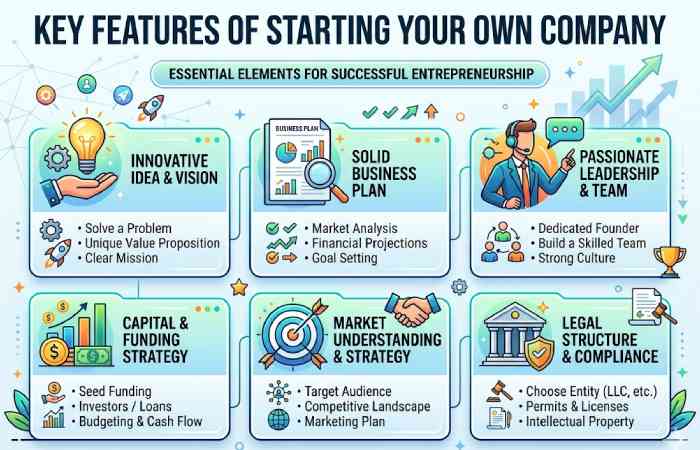
Key Features of Starting Your Own Company
Advantages and Disadvantages of Starting Your Own Company
| Advantages | Disadvantages |
| Be Your Own Boss – Full control over decisions and direction | High Financial Risk – Personal savings often at stake |
| Unlimited Earning Potential – Income grows with business success | Irregular Income – No guaranteed monthly salary |
| Flexible Working Hours – Control your schedule | Long Working Hours – Often requires 60–80 hours/week |
| Creative Freedom – Freedom to innovate and build your vision | High Responsibility – All success and failure rest on you |
| Personal Growth – Builds leadership, resilience, and skills | Stress & Pressure – Deadlines, cash flow, and competition |
| Build an Asset – Business can be sold or scaled | Slow Initial Growth – Profits take time |
| Tax Benefits – Deductions and incentives in many countries | Legal & Compliance Issues – Regulations and paperwork |
| Job Creation – Opportunity to employ others | Market Uncertainty – Customer demand can change |
| Direct Customer Impact – Stronger relationships with customers | Lack of Stability – Business may fail if not managed well |
| Independence – No corporate politics | Limited Personal Time – Work-life balance can suffer |
10 Steps to Start Your Business
| Step No. | Step Name | What It Involves | Key Outcome |
| 1 | Identify a Business Idea | Find a problem to solve or a market gap based on skills and demand | Clear business concept |
| 2 | Market Research | Analyze target audience, competitors, and industry trends | Validated idea with demand |
| 3 | Create a Business Plan | Define goals, strategy, pricing, operations, and finances | Roadmap for growth |
| 4 | Choose a Business Name | Select a unique, memorable, and brand-friendly name | Brand identity |
| 5 | Legal Structure & Registration | Register as Sole Proprietor, LLP, LLC, or Pvt Ltd | Legal compliance |
| 6 | Secure Funding | Use savings, loans, investors, or grants | Financial stability |
| 7 | Open Business Bank Account | Separate personal and business finances | Professional financial management |
| 8 | Build Your Brand & Online Presence | Logo, website, social media, SEO, marketing assets | Market visibility |
| 9 | Launch Products or Services | Test offerings, set pricing, and go live | Revenue generation |
| 10 | Marketing, Sales & Scaling | Once your company is established, developing a clear strategy to build your business can help you strengthen your online presence, attract customers, and create sustainable growth. | Business growth & scalability |
How to Start a Home-Based Business?
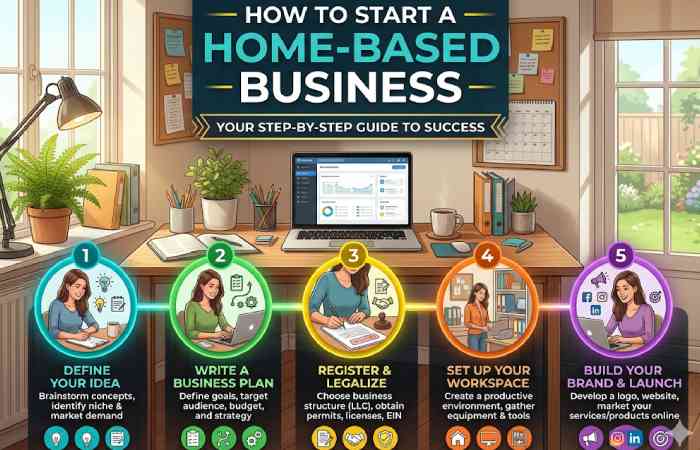
Starting a home business is one of the smartest ways of making money independently with low risk and low investment. The following is a clear step-wise working guidance in 2024–2025, if you are starting right from zero.
Step 1: Choose the Right Home-Based Business Idea
If you are interested in health and wellness, starting a fitness business can be another option to explore, whether through personal training, online coaching, or fitness-related products and services.
What do you possess right now? Competencies, duration, area, and funds.
Popular Home-Based Business Ideas
- Services offered online (SEO, digital marketing, content writing).
- Crafts, candles, ribbon flowers, jewelry handmade products.
- Services related to beauty and wellness.
- Home-based food business baking, snacking, pickling.
- Selling online means selling a product or service on any online platforms.
- Instructor or teaching (online/offline).
Choose something you can start small and scale later.
Step 2: Validate Your Idea (Don’t Skip This)
Before investing money, check demand.
Simple validation methods:
- Search your idea on Google and Instagram
- Check Amazon/Meesho for similar products
- Ask friends or post polls on WhatsApp/Instagram
- Start with pre-orders
If people show interest without discounts, your idea is viable.
Step 3: Set Up Your Home Workspace
You don’t need a big setup.
Essentials:
- Clean, quiet space
- Good lighting
- Basic tools (laptop/phone, internet)
- Storage space (for products)
Keep business items separate from personal items.
Step 4: Legal & Registration Basics (India)
For most home-based businesses, start simple.
Required (Based on Business Type)
- Business name
- Current bank account
- UPI / payment apps
Optional but Recommended
- GST registration (mandatory if turnover exceeds limit)
- Udyam (MSME) registration – free & helpful
- FSSAI license (for food business)
Start small—register more as income grows.
Step 5: Price Your Product or Service Correctly
Never price blindly.
Pricing formula:
Cost of material + Time cost + Packaging + Profit
Example (Handmade product):
- Material: ₹50
- Time (1 hour): ₹150
- Packaging: ₹20
- Profit: ₹80
Selling Price = ₹300
Step 6: Create Your Online Presence
You don’t need a website on Day 1.
Start With:
- Instagram Business Page
- WhatsApp Business
- Google Business Profile (for local services)
Later you can add:
- Website
- Amazon/Meesho store
- Online payment links
Step 7: Get Your First Customers
Focus on trust + visibility.
Easy Ways to Get Customers
- Share in WhatsApp groups
- Post before/after photos
- Offer launch discounts
- Ask happy customers for reviews
- Collaborate with local influencers
Your first 10 customers are the most important.
Step 8: Manage Orders & Customer Service
Good service = repeat business.
Best practices:
- Respond quickly
- Be honest about delivery time
- Use simple order tracking
- Keep records of sales & expenses
Step 9: Reinvest & Scale Slowly
Once you earn consistently:
- Improve packaging
- Buy tools in bulk
- Run small ads
- Expand product range
Never scale faster than you can manage.
Step 10: Stay Consistent & Patient
Most home-based businesses:
- Take 2–3 months to stabilize
- Become profitable with consistency
- Grow faster through word-of-mouth
Success doesn’t happen overnight—but it does happen.
Common Mistakes to Avoid
- Spending too much at the start
Copying competitors blindly
Underpricing your work
Giving up too early
How to Start a Business From Scratch in 7 Steps
| Step No. | Step Name | What You Need to Do | Result / Goal |
| 1 | Find a Profitable Idea | Identify a problem, validate demand, and check competition | Clear, viable business idea |
| 2 | Research Your Market | Define target audience, pricing, and competitors | Market fit & reduced risk |
| 3 | Create a Simple Business Plan | Outline goals, costs, revenue model, and strategy | Clear direction |
| 4 | Register Your Business | Choose structure (Sole, LLC, Pvt Ltd) and complete legal setup | Legal & trusted business |
| 5 | Build Your Brand & Product | Create logo, website, MVP, or service offering | Ready-to-launch business |
| 6 | Launch & Market | Use SEO, ads, social media, and networking | First customers |
| 7 | Track, Improve & Scale | Analyze performance, optimize, and expand | Sustainable growth |
How to Start a Business Without Money
Bootstrapping tactics that require time and hustle, not cash.
- Start with a service or skill
- Services need little capital: consulting, freelance design, tutoring, virtual assistance, event help. Use marketplaces (freelance sites, local classifieds).
- Pre-sell or take deposits
- Offer pre-orders, discounted pre-launch packages, or paid pilots to fund initial work.
- Barter & trade
- Offer your service in exchange for things you need (website design, photography, space). Make formal agreements.
- Use free tools & platforms
- Transactions: PayPal/Stripe; promotion: social media posting, neighborhood groups; landing pages: no-cost websites, social profiles; email: free tier.
- Leverage sweat equity and partnerships
- Find co-founders or collaborators who provide skills for equity; partner with existing businesses to reach customers.
- Create content to attract customers
- Free content (short videos, blog posts, social) builds organic traffic. Focus on helpful content that answers buyer questions.
- Microloans / grants / competitions
- If necessary, apply for microloan programs, small business grants, or pitch competitions, which usually requires just a minimum plan and not collateral.
- Minimal inventory / dropshipping / print-on-demand
- Sell products without holding stock by using dropshipping or print-on-demand services.
- Turn assets into cash
- Sell unused items, rent out a room, or do short freelance gigs to fund the first month of operations.
- Keep overhead tiny
- Work from home, avoid unnecessary subscriptions, hire freelancers for short tasks only when revenue is there.
Action today: pick one sellable service, create a social post describing it, and ask 10 people if they’d pay for it.
The 2025 Bootstrapper’s Tech Stack: Free and Low-Cost Tools
| Business Stage | Tool Category | Free / Low-Cost Tools | What They’re Used For | Why They’re Ideal for Bootstrappers |
| Idea & Planning | Brainstorming & Docs | Google Docs, Notion (Free) | Business plans, notes, workflows | Zero cost, cloud-based, easy collaboration |
| Market Research | SEO & Trends | Google Trends, AnswerThePublic (Free tier), Ubersuggest | Demand validation, keyword ideas | Helps avoid building products no one wants |
| Branding | Design | Canva (Free), Adobe Express | Logos, social posts, flyers | No design skills needed |
| Website Setup | CMS & Hosting | WordPress + Free themes, GitHub Pages | Website or landing page | Flexible, scalable, low setup cost |
| Email & Communication | Email & Chat | Gmail, Zoho Mail, Slack (Free) | Business communication | Professional presence at no cost |
| Marketing | Social Media | Instagram, LinkedIn, Buffer (Free tier) | Audience growth & content scheduling | Organic reach without ad spend |
| Sales | Payments | Razorpay, Stripe, PayPal | Accepting online payments | Pay-as-you-go pricing |
| Operations | Task Management | Trello, ClickUp (Free) | Task tracking & workflows | Keeps work organized without hiring |
| Analytics | Tracking | Google Analytics, Search Console | Performance & traffic insights | Essential data for growth decisions |
| Accounting | Finance | Wave, Zoho Books (Free plans) | Expense tracking, invoicing | Avoids costly accounting software early |
Why this stack works in 2025:
Founders who bootstrap their business need flexibility, not complexity. These tools easily integrate into your business and grow along with it. The expense remains manageable and not overwhelming. This price.
10 Things to Know Before Starting a Business
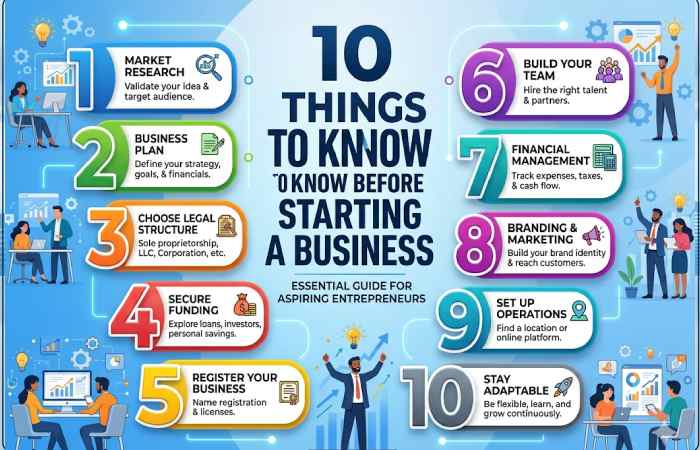
High-impact things every founder should understand.
- Who your customer is (market segmentation)
Be specific: age, job, income, habits. Broad audiences waste effort.
- Your unique value proposition (UVP)
What makes you different and why customers should pick you.
- How you’ll make money (business model)
Clear revenue streams and pricing logic. Know your margins.
- Startup costs & runway
Real estimate of first-month and monthly running costs. Know how many months you can operate.
- Basic legal & tax requirements
Registration, licenses, taxes, invoicing rules. Compliance gaps cause big problems later.
- Simple bookkeeping & cashflow management
Track every rupee in/out. Cashflow is more important than profit early on.
- Customer acquisition strategy
How will customers find you? (referrals, ads, marketplaces, content). Know the cheapest & fastest channel.
- Unit economics & key metrics
Know CAC (cost to acquire a customer) and LTV (lifetime value). If CAC > LTV, it won’t scale.
- Operations & capacity
Can you fulfill orders or deliver the service at scale? Document processes early.
- Mindset & perseverance
Expect setbacks. Focus on learning fast, iterating, and staying cash-aware.
Best Tools to Start Your Own Company
| Category | Tool Name | Purpose | Pricing | Resources / Website |
| Idea Validation | Google Trends | Market demand & trend analysis | Free | https://trends.google.com |
| AnswerThePublic | Customer pain points & keyword ideas | Free / $11–$99/mo | https://answerthepublic.com | |
| SurveyMonkey | Customer surveys & feedback | Free / $25–$99/mo | https://www.surveymonkey.com | |
| Business Planning | LivePlan | Business plans & financial forecasting | $20–$40/mo | https://www.liveplan.com |
| BizPlan | Startup planning & investor decks | ~$19/mo | https://www.bizplan.com | |
| Market Research | Statista | Industry & market data | Free / $49+ | https://www.statista.com |
| Company Registration | LegalZoom | Business registration & compliance | $0–$299+ | https://www.legalzoom.com |
| ZenBusiness | Business formation services | $49–$299 | https://www.zenbusiness.com | |
| Finance & Accounting | QuickBooks | Accounting & bookkeeping | $30–$200/mo | https://quickbooks.intuit.com |
| Wave | Free accounting & invoicing | Free | https://www.waveapps.com | |
| Branding & Design | Canva | Logo, brand kits, marketing design | Free / $12.99/mo | https://www.canva.com |
| Looka | AI-powered logo & branding | $20–$96 (one-time) | https://looka.com | |
| Website Creation | WordPress | Business website & blog | Free / Paid hosting | https://wordpress.org |
| Wix | Drag-and-drop website builder | Free / $16–$59/mo | https://www.wix.com | |
| Marketing & SEO | Semrush | SEO, content & competitor analysis | $139.95+/mo | https://www.semrush.com |
| Mailchimp | Email marketing & automation | Free / $13–$350/mo | https://mailchimp.com | |
| Project Management | Trello | Task & workflow management | Free / $5–$17.50/mo | https://trello.com |
| Notion | Notes, planning & team collaboration | Free / $10+/mo | https://www.notion.so | |
| Payments & Invoicing | Stripe | Online payments | 2.9% + fees | https://stripe.com |
| PayPal | Global payment processing | 2.99% + fees | https://www.paypal.com | |
| Customer Support | Zendesk | Customer service & ticketing | $55+/mo | https://www.zendesk.com |
4 Things To Think About Before Opening Own Company
Budget
Typically, the type of business you start will determine how much money you have. You can’t spend what you don’t have because you don’t have it. You may require modest or large sums of money, depending on the nature of your firm. On the other hand, firm experts advise that people begin by investing little sums of money and gradually increase their investment as the business grows. This is frequently done to reduce the odds of a company failing. You’ll need a well-defined plan for covering these costs to budget appropriately. You can utilize your savings or borrow money from friends and family or a lending institution.
Target Audience
Entrepreneurship is a journey that entails a slew of tasks that must be completed correctly to get the best results. Before launching a business, you must well-verse in various topics and tactics to succeed. After all, you aren’t the only one working in this industry.
You’ll find many established businesses that are comparable to yours and have a good reputation. However, you will gradually generate money with patience and strenuous effort. The market has transitioned to the digital arena due to current technological advances. According to statistics, at least 80% of individuals look for items and services online before purchasing them.
Competition
You must examine the amount of competition in the sector before launching a firm. The number one cause that kills many small firms is competition. If you enter a business without first learning about the competitors, there’s a reasonable probability you’ll be out of business soon.
Experts advise companies to stay away from highly competitive areas, and this is due to well-known brands having a significant market share. These brands also have a competitive edge over new enterprises, which means they may charge lower prices for their goods and services while remaining competitive.
Risk
Every firm has its own set of dangers. As a result, entrepreneurs must think about the degree of risk before starting a firm. When you first create your firm, you must analyze, comprehend, and plan for the dangers you will face. Since you’re just getting started, it’s not worth taking big chances because they might end up costing you more in the long run. Even if you insure your firm against the risk, you may still be unable to recover the obligations, especially if the cause of the collapse is unclear.
These are the most important things to think about before beginning your own company. It is critical to conduct extensive studies on the file you invest in. You’ll also need a well-thought-out business strategy and a mentor to guide you through the process.
When to Hire Your First Employee: A Financial Readiness Checklist
| Financial Area | Key Question to Ask | What “Ready” Looks Like | Why It Matters |
| Revenue Stability | Is income consistent? | 6–12 months of steady revenue | Prevents panic hiring during short-term growth |
| Cash Reserve | Can you pay salary without sales? | 6 months of salary in reserve | Protects business during slow periods |
| Profitability | Are you profitable after salary? | Payroll ≤ 30–40% of net profit | Ensures business stays healthy |
| Role Clarity | Do you know what you’re hiring for? | Clear job description & KPIs | Avoids wasted payroll |
| Workload Pressure | Is work limiting growth? | Founder is overloaded or missing opportunities | Hiring becomes an investment |
| Hidden Costs | Have you budgeted extras? | Tools, taxes, onboarding covered | Prevents unexpected expenses |
| Systems & Processes | Can work be delegated? | Tasks documented & repeatable | Makes training efficient |
| Legal Readiness | Are basics covered? | Contracts, compliance understood | Reduces legal risk |
| Long-Term Ability | Can you commit long term? | Salary affordable beyond short term | Hiring is a responsibility |
| Business Independence | Does hiring reduce dependency on you? | Business runs smoother with help | Indicates scalability |
Key insight:
Hiring too early drains cash. Hiring too late stalls growth. Financial readiness ensures your first employee strengthens the business instead of becoming a liability.
Fahmeena Begum is a Digital Marketing & Technology Writer at SlashdotBlog with 3+ years of writing experience. Her work covers digital marketing, technology, business, software, artificial intelligence and emerging digital trends.
View Author Profile →
Sameena Begum is a Technology & Digital Content Reviewer with 8 years of experience. Her review work focuses on editorial clarity, factual presentation, readability, consistency and reader usefulness.
View Reviewer Profile →