
Technology is evolving at a pace faster than ever before, transforming how people live, work, communicate, and conduct business. From artificial intelligence and smart devices to ultra-fast connectivity and advanced computing, modern innovations are shaping a future where digital systems are deeply integrated into everyday life.
As organizations continue to invest in digital transformation, understanding the top technology trends in 2026 has become essential for businesses, professionals, and even students who want to stay competitive in the modern world.
In this guide, we will explore the top technology trends in 2026, including their key features, estimated costs, real-world applications, and resources for further exploration. Whether you are a business leader planning your next digital investment, a technology enthusiast curious about future innovations, or a student exploring career opportunities in tech, understanding these trends will help you stay ahead in an increasingly technology-driven world.
Emerging Technology
Table of Contents
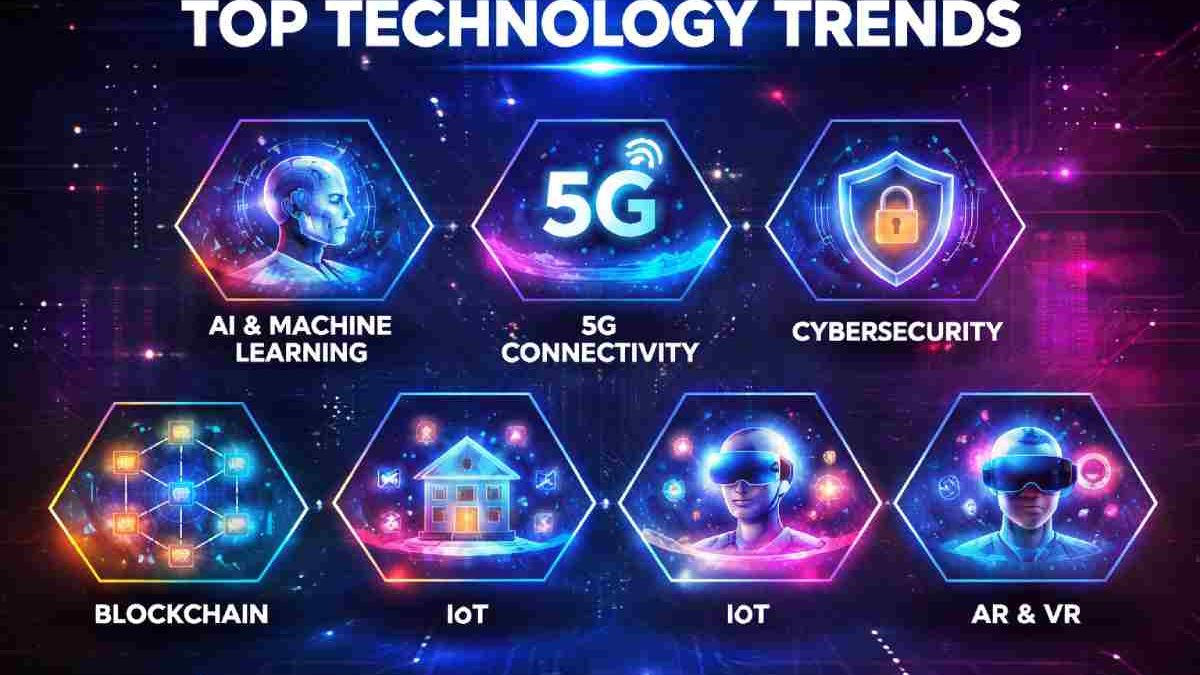
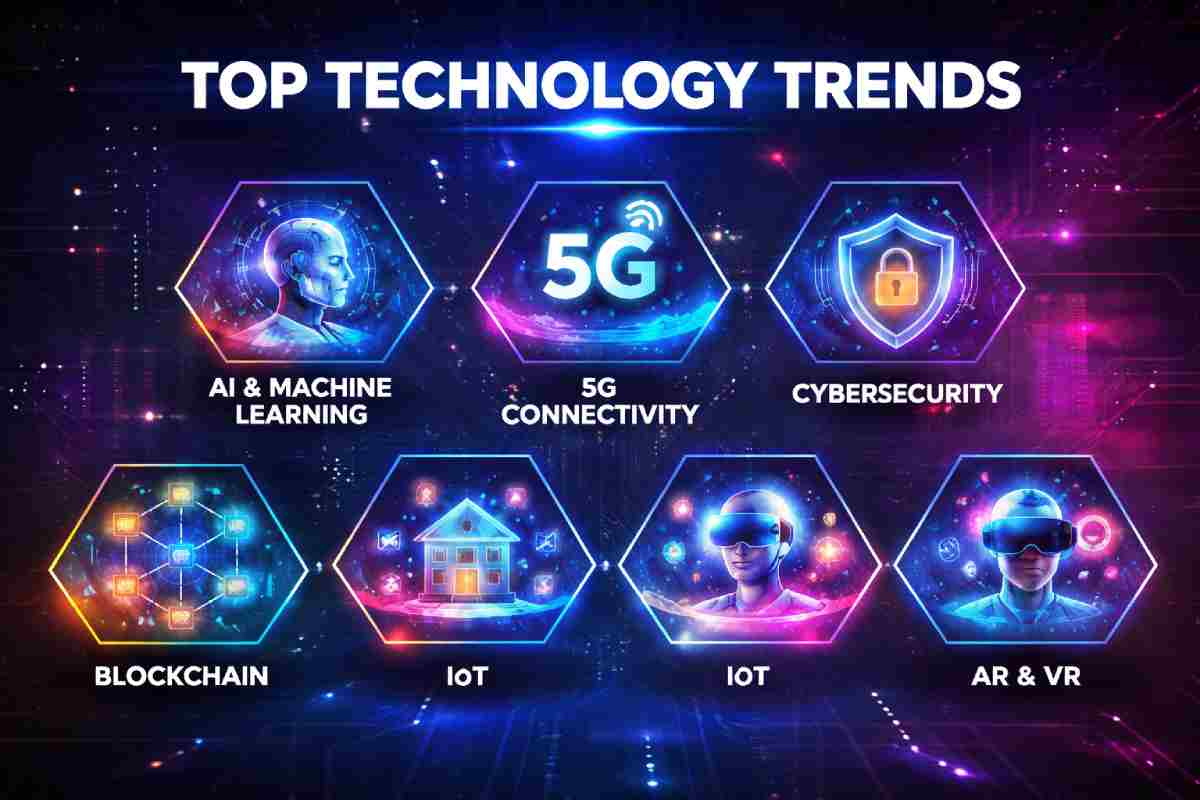
Top Technology Trends (2026)
| Technology Trend | What It Does | Estimated Cost / Price Range | Business Use Cases | Resource Link |
| Artificial Intelligence (AI) & Machine Learning | Automates decision-making, predictive analytics, and chatbots | $20,000 – $500,000+ enterprise deployment | Customer support, fraud detection, automation | https://cloud.google.com/ai |
| Generative AI & AI Copilots | Generates text, images, code, and assists employees | $10 – $60 per user/month or $50K+ enterprise | Content creation, coding assistants | https://openai.com |
| AI Agents (Autonomous AI Systems) | AI performing tasks automatically like digital workers | $5,000 – $200,000+ system development | workflow automation, operations management | https://aws.amazon.com/ai |
| Internet of Things (IoT) | Connects smart devices and sensors to the internet | $10 – $200 per sensor device | smart homes, smart factories | https://aws.amazon.com/iot |
| AIoT (AI + IoT) | Combines AI analytics with connected devices | $50,000 – $1M+ enterprise systems | predictive maintenance, automation | https://www.ibm.com/internet-of-things |
| 5G Networks | Ultra-fast wireless connectivity | $1M – $10M+ telecom infrastructure | smart cities, autonomous vehicles | https://www.qualcomm.com/5g |
| Edge Computing | Processes data closer to the device | $10,000 – $150,000 infrastructure | real-time analytics, IoT processing | https://www.ibm.com/cloud/edge-computing |
| Extended Reality (AR/VR) | Virtual and augmented reality experiences | $3,000 – $400,000+ development | Virtual and augmented reality are also expanding beyond entertainment, with virtual reality in schools creating new possibilities for interactive lessons, simulations, and immersive learning experiences. | https://unity.com/solutions/vr |
| Blockchain & Web3 | Secure decentralized transactions and digital identity | $30,000 – $1M+ project development | fintech, supply chain | https://ethereum.org |
| Quantum Computing | Advanced computing solving complex scientific problems | $5,000 cloud access – $10M+ research labs | drug discovery, cryptography | https://quantum.ibm.com |
| Cloud Computing | Scalable computing resources via the internet | $100 – $10,000+ monthly enterprise usage | SaaS platforms, data storage | https://aws.amazon.com |
| Cybersecurity & Zero-Trust Architecture | Protects networks and data from cyber attacks | $5,000 – $500,000 enterprise security | data protection, enterprise security | https://www.paloaltonetworks.com |
New Technology Trends Roartechmental
The term “Roartechmental” can function as a conceptual framework to describe technology trends that exhibit rapid adoption, transformational impact, and psychological/behavioral influence on users, organizations, and society.
Characteristics of Roartechmental Trends
- Rapid Acceleration: Adoption accelerates faster than traditional diffusion curves
- Operational Impact: Causes measurable shifts in business practices
- Human-Tech Interface Influence: Alters user behavior and expectations
- Cross-Sector Penetration: Moves beyond niche verticals into broad industry use
Examples in 2025
| Roartechmental Trend | Driver | Measurable Impact |
| Conversational AI | NLP improvements | Customer service automation |
| Autonomous Systems | Robotics + AI | Logistics and mobility shifts |
| Generative AI | Deep learning models | Content automation, creative workflows |
| Digital Identity Frameworks | Security and privacy demand | User authentication |
Research Note: Trends that qualify as “roartechmental” often align with high venture capital investment, research intensity, and enterprise innovation roadmaps.
Research Insights: Technology Trends
The current trends in technology are dependent on the pace of enterprise adoption, investment in the market as well as the estimated economic consequences. According to the industry analysts, technology experts, and patent statistics, there are general trends in industry-wide digital transformation priorities.
Technology Trends by Adoption and Impact
| Trend | Adoption Level (Global) | Key Benefits | Estimated Market Value by 2030 |
| Artificial Intelligence (AI) & Machine Learning (ML) | Very High | Automation, predictive analytics | $1.5–2T+ |
| Internet of Things (IoT) | High | Connectivity, real-time monitoring | $1.4T+ |
| 5G Connectivity | Growing Rapidly | Low latency communications | Core to $2T+ ecosystem |
| Edge Computing | Medium | Local data processing, reduced latency | $250B+ |
| Blockchain & Web3 | Emerging | Decentralized security | $100–$150B+ |
| Extended Reality (AR/VR) | Emerging | Immersive experiences | $300–$500B+ |
| Quantum Computing | Low (Early) | Complex problem solving | Long-term, high potential |
Research Insight: AI and IoT are two of the broadly used enterprise technologies currently deployed by 2025 and crossing industry penetrations of over 4060% in larger companies. The use of blockchains is still centralized in fintech and supply chain. IoT and 5G implementations trigger the development of edge computing.
Macro Drivers of Technology Trends
Global Influencers
- Cloud Infrastructure Growth: Public and hybrid cloud investments have increased by more than a single-digit every year, which allows scaling services and analytics.
- Remote and Hybrid Work: Digital collaboration and cybersecurity solutions have seen sustained investment since 2020.
- Data Proliferation: Exponential data growth drives demand for analytics, storage, and AI-based insights.
Organizational Priorities
Research surveys of global CIOs and CTOs consistently list the following priorities:
- Cybersecurity enhancement
- AI-based automation
- Customer experience optimization
- Digital supply chain resilience
- Sustainable and low-carbon technologies
Emerging Technologies: Functions and Valuations
| Emerging Tech | Core Function | Current Research Focus |
| AI & ML | Automate decisions, predictions | Responsible AI, explainability |
| Blockchain | Decentralized ledger | Scalability, energy efficiency |
| Edge Computing | Local compute resources | Deployment orchestration |
| AR/VR | Simulated environments | Enterprise training, user engagement |
| Quantum | Advanced computation | Error correction, business use cases |
Technology Trends by Sector
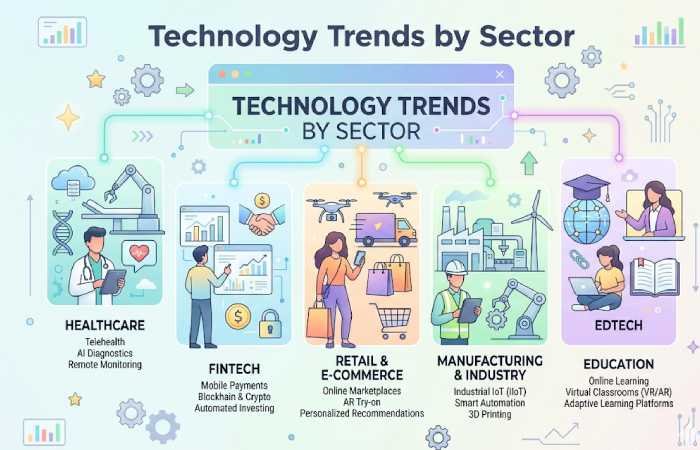
Healthcare
- Predictive diagnostics using AI models
- Remote patient monitoring via IoT
- Digital therapeutics and telehealth expansion
Research shows that AI in healthcare could improve diagnostic accuracy by 20–30% in some applications and reduce operational costs.
Finance
- Automated trading and risk evaluation
- Blockchain in settlement and identity
- Fraud detection via ML pattern recognition.
Another major technology trend is blockchain, which continues to support new applications in digital transactions, data security, decentralized systems, and other technology-driven services.
Financial services account for one of the leading sectors in blockchain patent filings and institutional deployments.
Manufacturing
- Smart factories with IoT sensors
- Process optimization through digital twins
- Robotics and autonomous material handling
Manufacturing digital transformation spending is consistently among the top three for industrial sectors globally.
Adoption Challenges (Research-Based)
Although trends are accelerating, organizations face hurdles:
- Skill Gaps: High demand for data scientists, cloud engineers, and cybersecurity experts
- Integration Complexity: Legacy systems limit rapid technology uptake
- Security and Privacy: Data governance remains a core concern
- Regulation: Emerging compliance standards for AI and data usage
Surveys indicate that 30–45% of enterprises cite the lack of skilled workforce as a major barrier to adoption.
Economic Projections of Key Trends
| Trend Category | 2025 Estimated Value | Growth CAGR |
| AI & Analytics Platforms | $1500B+ | 30%+ |
| IoT Devices & Platforms | $1,400B+ | 27%+ |
| 5G Infrastructure | Core enabler | Rapid |
| Cybersecurity Solutions | $345B+ | 9–12% |
| Quantum Technologies | Early markets | High but nascent |
Technology Competitor Landscape (Platforms)
| Platform | Core Technology | Pricing Model | Resource Link |
| AWS AI Services | Cloud AI | Pay-as-you-go | https://aws.amazon.com/ai |
| Google Cloud AI | ML APIs | Usage-based | https://cloud.google.com/ai |
| Microsoft Azure AI | AI + cloud | Enterprise subscription | https://azure.microsoft.com |
| IBM Watson | Enterprise AI | Custom pricing | https://www.ibm.com/watson |
| NVIDIA AI Platform | GPU computing | Hardware + cloud | https://nvidia.com |
Country-Wise Technology Investment
| Country | Annual Tech Investment | Key Sector |
| USA | $400B+ | AI, chips |
| China | $350B+ | smart manufacturing |
| EU | $200B+ | green technology |
| Saudi Arabia | $100B+ | smart cities |
| India | $90B+ | digital services |
Technology Trends by Industry (Advanced)
Healthcare Technology Market
| Technology | Adoption Level | Estimated Cost | Benefit |
| AI diagnostics | High | $100K+ | Faster disease detection |
| Wearable IoT devices | High | $50–$300 | Remote monitoring |
| Telemedicine platforms | Very High | $20K+ | Virtual consultations |
| Genomics AI | Emerging | $200K+ | Personalized medicine |
Finance Technology Trends
| Technology | Impact | Example |
| AI trading | Automated investing | hedge funds |
| Blockchain payments | Faster settlements | crypto payments |
| Digital identity | Fraud prevention | biometric login |
| Open banking APIs | fintech integration | digital wallets |
Manufacturing Technology
| Technology | Productivity Gain |
| Smart factories | 30% efficiency |
| Predictive maintenance | 40% cost reduction |
| Robotics automation | 50% faster production |
| Digital twins | 20% downtime reduction |
Predictive maintenance systems alone can reduce downtime by up to 90% in industrial environments.
Technology Startup Ecosystem
Top startup sectors attracting venture capital:
| Sector | VC Investment |
| Artificial Intelligence | $80B+ |
| Climate technology | $60B+ |
| Cybersecurity | $40B+ |
| Robotics | $30B+ |
| Biotech | $70B+ |
Technology Risks and Barriers
| Challenge | Impact |
| Talent shortage | Lack of AI engineers |
| Data privacy regulation | Compliance complexity |
| Cybersecurity threats | Data breaches |
| Infrastructure costs | High implementation cost |
Nearly 30–45% of enterprises report skills shortages as the biggest barrier to technology adoption.
Coding Gets a Brain Boost (Future of Programming)

Say hi to Software 2.0, where coders team up with brainy neural networks (AI that learns) to write programs faster. It’s like having a robot helper who suggests code lines, making tricky stuff like self-driving car software easier to build. This trend lets you tweak old code like editing a storybook and automates boring coding chores. It’s as if your coding homework got a super-smart tutor to make it quicker and more fun!
Super Safe Tech World (Trust Architecture)
With hackers lurking like sneaky foxes, trust architecture builds tough forts for your data. It uses tools like Blockchain (a digital lockbox for info) and zero trust security (checking everyone, every time) to stop cyber bad guys. These keep your info safe, make following rules cheaper, and let businesses trade without worry. It’s like having an invisible shield around your secret clubhouse, so only trusted pals get in!
Life-Changing Science (Bio-Revolution)
The Bio-Revolution mixes biology with tech – think AI, robots, and super computers – to spark a wave of cool inventions. It’s huge for health (new medicines!), farming (better crops!), snacks (tastier treats!), energy, and more. Things like biomolecules (DNA and protein stuff) and omics (studying life’s building blocks) are growing fast. Soon, you might get food or medicine made just for you, like a custom smoothie or a vaccine whipped up in a flash. It’s like science fiction turning real, creating new markets for personalized goodies!
Awesome New Stuff (Next-Generation Materials)
It is all being transformed by new materials such as graphene (super strong, thin stuff), molybdenum disulfide nanoparticles and other miniature and intelligent materials. They are lighter, tougher and nicer to the planet, assisting in creating better medicines, cars, phones and even environment-friendly factories. Others are in labs yet others are nearly ready to shine. Imagine a bendy phone that will not snap or clothes that will charge your phone that is the future!
Green Power for a Happy Planet (Future of Clean Technology)
Clean tech is everything about the Earth, and new energy tricks, such as solar panels, wind turbines, or fusion power (mini suns to generate electricity). It discusses smart power grids, electric vehicles, energy-efficient houses, and clean water. They reduce pollution and make life viable, such as replacing a gas-guzzler with an electric scooter. It is noteworthy to keep our world green and happy!
Future Technology Predictions (2030)
Experts expect several breakthrough technologies:
AI Agents
Autonomous digital assistants performing complex business tasks.
Brain–Computer Interfaces
Direct interaction between the human brain and machines.
Autonomous Transportation
Driverless taxis and logistics systems.
Synthetic Biology
Engineered organisms producing food and medicines.
Space Technology
Satellite internet and commercial space stations.
Wrapping It Up: Get Ready for the Tech Party!
These trends are the preview of tomorrow world – and it is coming very soon! Being prepared also involves venturing on to these cool changes today so that you are not taken by surprise when they occur. It could be smarter robots, quick connections, or green devices but either way, they are an opportunity to make life in Saudi Arabia and the world better. Take it as a pre-match training – master the tricks and you will get a lot of points once the second time comes!
Advances in battery technology are also shaping the future of consumer electronics and electric mobility. Companies such as Enovix are developing innovative battery technologies aimed at improving energy density and performance.