
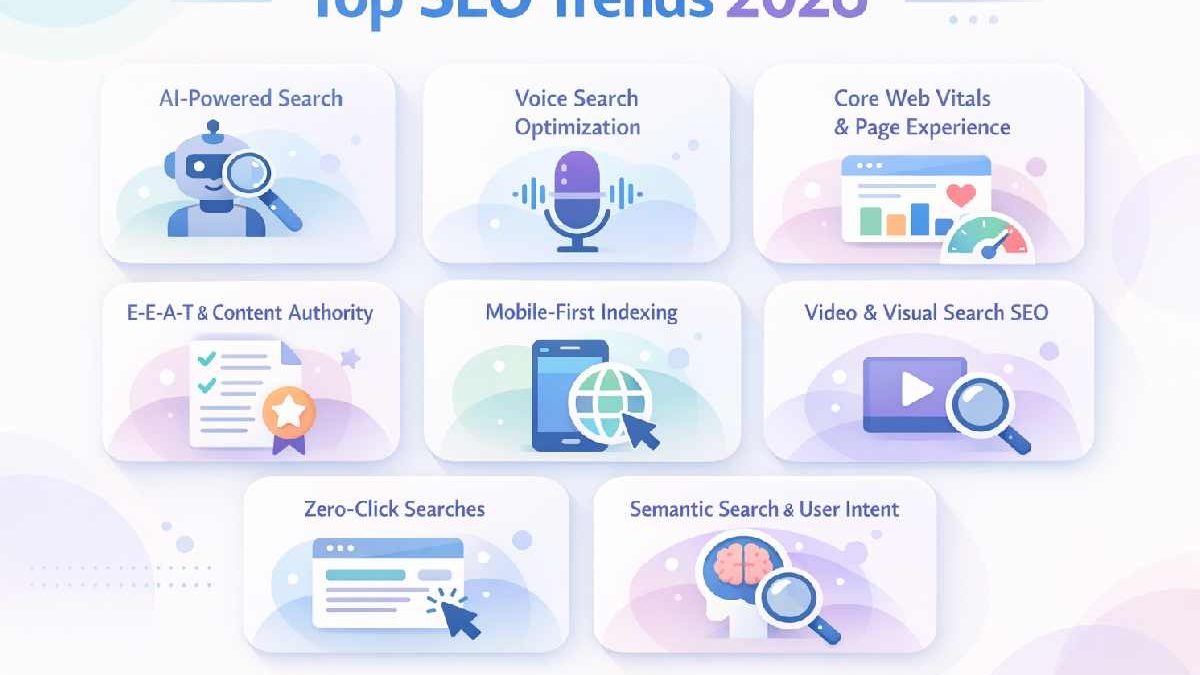
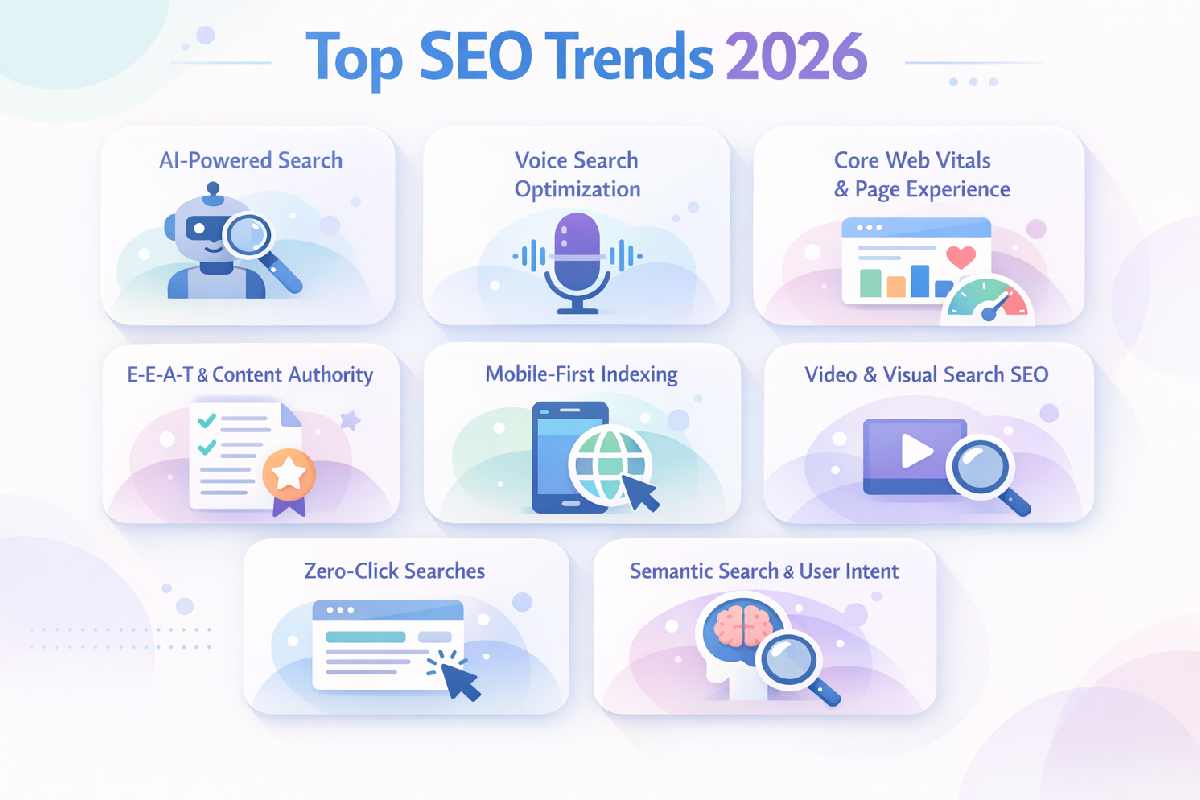
SEO trends keep on changing. Furthermore, as new technologies are being developed, new challenges are presented to the search and creation of new content. However, since some trends in the sphere of SEO will be preserved in 2022, new trends will also appear. Consequently, the team of Digital Marketers will have to monitor the 2022 trends in SEO that are going to persist in the current year. And on the other those that will fly.
SEO
Table of Contents
What are SEO Trends?
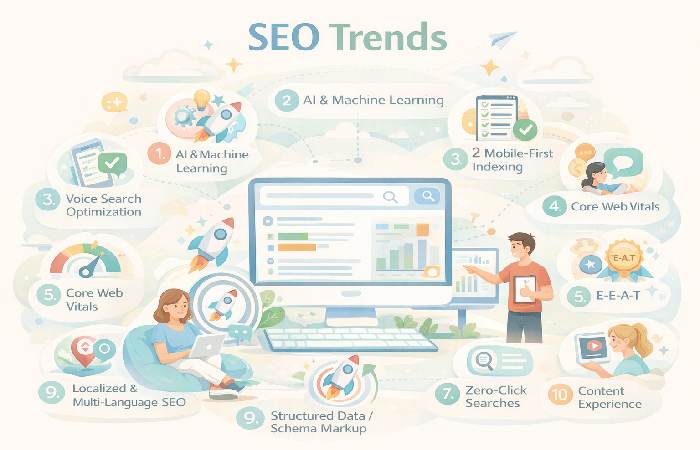
SEO trends are the changing of strategies, technologies and ranking factors which determine the way a web site will be ranked in a search engine such as Google. These trends evolve due to the fact that search engines modify their algorithms, the behavior of users is changing and new technologies (such as AI and voice search) are being developed.
Features of SEO Trends
For businesses looking to attract more website traffic, improving search visibility through relevant content, technical SEO, and local optimization can make a significant difference.
| SEO Trend Feature | Description | Why It Matters | Impact on Rankings |
AI-Driven SEO |
Use of AI for content generation, intent analysis, and predictive optimization (AEO/GEO) | Improves content relevance and search visibility in AI-powered results | High |
Mobile-First Indexing |
Google prioritizes mobile version of websites for indexing and ranking | Majority of users search on mobile devices | High |
Voice Search Optimization |
Optimizing for conversational, question-based queries | Increases visibility in voice assistants (Alexa, Google Assistant) | Medium-High |
Visual Search Optimization |
Image-based search using tools like Google Lens | Enhances product and brand discoverability | Medium-High |
Zero-Click Search Results |
Featured snippets, knowledge panels, and instant answers | Improves brand visibility without requiring clicks | Medium-High |
Core Web Vitals (UX Signals) |
Page speed, interactivity, and visual stability metrics | Enhances user experience and engagement | High |
E-E-A-T (Experience, Expertise, Authority, Trust) |
Focus on credible, authoritative content | Builds trust and improves long-term rankings | High |
Localized SEO |
Country, city, and region-specific optimization | Essential for local businesses and services | Medium-High |
Multilingual SEO |
Optimizing content for multiple languages and regions | Expands global reach and international traffic | Medium-High |
Structured Data / Schema Markup |
Code that helps search engines understand content | Enables rich results and higher CTR | Medium-High |
Content Experience Optimization |
Content designed for engagement, clarity, and intent | Reduces bounce rate and improves dwell time | Medium-High |
Search Intent Optimization |
Aligning content with informational, transactional, or navigational intent | Improves conversions and relevance | High |
Why Is SEO Still Important in 2025?
SEO still matters in 2025 because people are still looking up things on Google, 24/7. Despite the growth of AI tools, search engines are still the primary location for customers seeking information, products, reviews and local services. Customers will find your competitors instead of you, if your site is not on the first page.
Key reasons SEO still matters:
- Organic traffic is free and long-term
You don’t have to pay for every click like ads. Good SEO brings consistent visitors for months and years.
- Google search is evolving, not dying
With AI Overviews and smarter algorithms, Google is giving better results — but you still need SEO to appear in them.
- Builds trust and authority
People trust websites that appear at the top. Ranking high increases your brand value.
- SEO helps with user experience
The fast loading mobile-friendly design and easy to read content, make them stick longer and convert better.
- Your competitors are doing SEO
They will out rank you, if you take a break. SEO is an investment in visibility for the long-haul.
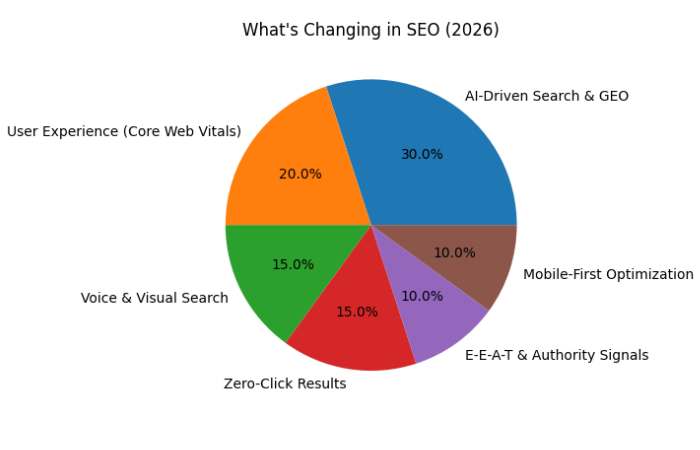
What’s Changing in Seo?
Top SEO Trends — Country-Wise Presence (2026)
Region / Country |
Top SEO Trends |
Typical Pricing (SEO Services) |
User / Expert Reviews |
Key Resources |
United States |
• AI-driven SEO & GEO/AEO optimization • Voice & visual search growth • Mobile-first indexing • Zero-click / answer results focus |
Freelancer/Consultant: $500–$2,000/month Small Agency: $1,500–$5,000/month Enterprise: $5,000–$20,000/month |
Reviews emphasize importance of AI content, structured data, and mobile UX. Many US agencies are rated highly for technical and local SEO quality. | • SEO Trends 2026 — WebFX insights (AI, forums, visibility) • SEO Practices & Costs — Credofy (pricing) |
United Kingdom (Europe) |
• Multilingual & localized content optimization • Technical SEO (GDPR/UX compliance) • Zero-click search adaptation • AI-driven SERP visibility |
Retainer/Subscription: £1,000–£8,000+/month (varies by agency size and complexity)¹ | UK SEO reviews praise strong compliance focus (technical and privacy) and multilingual strategies. Consistency and localized content are often highlighted. | • SEO Software Market — Europe regional share (GER, UK, FR) • Country insights (EU diversity & SEO) |
India (Asia-Pacific) |
• Mobile-first & local SEO dominance • AI predictive optimization • Visual & voice search rise • Predictive analytics and user intent modeling |
Hourly: $12–$35 Monthly Retainer: $500–$2,000 (offshore SEO pricing) |
Indian SEO reviews remark on affordable pricing, rapid adoption among SMEs & startups, and strong content SEO focus. Quality varies widely across providers. | • Offshore SEO Pricing — India benchmarks • APAC SEO trends & predictive SEO |
Germany (Europe) |
• Structured data & technical SEO • Cross-border SEO (multilingual) • Core Web Vitals & UX |
Agency retainer: €2,000–€10,000+/month | German SEO services are often praised for technical thoroughness & enterprise use cases, especially in e-commerce and multilingual markets. | • Europe SEO share insights (Germany lead) |
China (APAC) |
• Local search engines (Baidu) focus • Mobile & app SEO • Social-commerce SEO |
Varies widely (agency quotes dependent on local SEO needs) | Trend reviews emphasize Chinese search behavior and need for Baidu/WeChat ecosystem optimization. | • APAC market growth & trends (China focus) |
Australia |
• AI & mobile-first SEO • Local online visibility • Voice search trends |
Local Agency: AUD 2,000–AUD 10,000/month (varies) | Australia’s SEO context often parallels UK/US trends with strong local search investment and Google focus. | • SEO regional analysis Europe & APAC |
South Africa (MEA) |
• Mobile & local search growth • SME SEO adoption |
Retainer: $800–$3,000/month (estimated) | Emerging market reviews highlight rising demand but skill gap in advanced technical SEO. | • Middle East & Africa regional outlook |
Saudi Arabia (MEA) |
• E-commerce & mobile optimization • Local market SEO trends |
Estimates similar to MEA median | Local experts cite rapid digital transformation under Vision 2030, fueling SEO demand. | • Brazil & Saudi market growth, trends |
How to Rank Faster in 2026?
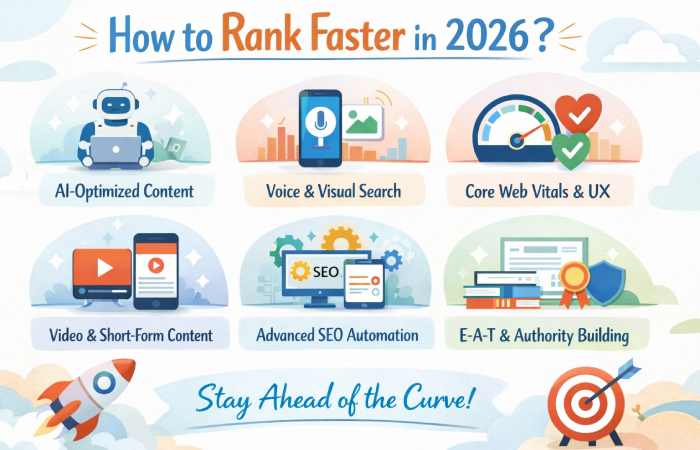
Staying updated with the latest SEO trends can also help small businesses adjust their strategies as search behavior and ranking systems continue to change.
Ranking faster in 2026 requires more than publishing content and waiting. With AI-driven search, entity-based indexing, and stronger user experience signals, you need a strategic acceleration framework. Below is a deep, tactical breakdown of how to shorten ranking timelines and gain visibility faster.
1. Target Low-Competition, High-Intent Keywords First
Most websites fail because they chase high-volume keywords too early.
What to do instead:
- Focus on long-tail keywords (3–6 words)
- Target keywords with low Keyword Difficulty (KD under 30 for new sites)
- Prioritize transactional or problem-solving intent
- Use keyword clustering (topic groups instead of single keywords)
Example:
Instead of “SEO tools,” target:
- “Best SEO tools for small ecommerce brands”
- “Affordable SEO tools under $100 per month”
Small businesses can also learn how to improve their visibility by understanding the key factors involved in ranking a small business website in search results.
Tools for Keyword Research:
- Ahrefs
- Semrush
- Ubersuggest
2. Optimize for Search Intent (Not Just Keywords)
Search engines now rank based on intent satisfaction, not keyword repetition.
There are four main intent types:
- Informational
- Transactional
- Navigational
- Commercial Investigation
How to rank faster:
- Analyze top 5 ranking pages
- Match their content format (guide, list, product page, video)
- Cover missing subtopics (content gap analysis)
- Add direct answers in first 100 words
3. Improve Technical SEO Immediately
Technical errors delay indexing and ranking.
Use:
- Screaming Frog
- Google Search Console
Critical fixes for faster ranking:
- Fix crawl errors
- Submit XML sitemap
- Improve internal linking
- Ensure mobile-first design
- Optimize Core Web Vitals
- Reduce page load time under 2.5 seconds
4. Build Topical Authority (Cluster Strategy)
Google measures authority largely through backlinks – links from other websites pointing to yours.
Instead of publishing random articles, create topic clusters.
Example Structure:
Pillar Page → 10–20 supporting articles → strong internal linking
Search engines prefer authoritative topic coverage.
Acceleration Tip:
Publish 5–10 interlinked articles within 30 days instead of 1 per month.
5. Acquire High-Quality Backlinks Quickly
Backlinks remain one of the strongest ranking factors.
Fast link-building methods:
- Guest posting
- Digital PR
- HARO responses
- Resource page outreach
- Broken link building
Cost Range (2026):
- Guest post: $100–$800
- Digital PR campaign: $2,000–$10,000
- Authority backlink: $300–$1,500
Quality > Quantity.
6. Optimize for AI Overviews & Featured Snippets
How to rank in snippets faster:
- Use 40–60 word direct definitions
- Add FAQ schema
- Use bullet lists and tables
- Answer “People Also Ask” questions
- Use clear H2/H3 formatting
7. Boost Page Experience Signals
Ranking speed improves when users engage.
Improve:
- Time on page
- Scroll depth
- CTR
- Internal click flow
Quick Wins:
- Add table of contents
- Use engaging visuals
- Add short videos
- Improve readability (short paragraphs)
8. Leverage Freshness & Content Updates
Google favors updated content.
Strategy:
- Update content every 60–90 days
- Add new data and statistics
- Expand content depth
- Improve meta titles for higher CTR
Websites that update content regularly rank faster than static sites.
9. Optimize for Mobile First
Since indexing is mobile-first:
- Use responsive design
- Avoid intrusive popups
- Ensure fast mobile load speed
- Compress images
- Test via PageSpeed Insights
Mobile rankings often appear faster than desktop when optimized properly.
10. Use Programmatic SEO (For Scale)
For SaaS, ecommerce, or service sites:
- Create dynamic landing pages
- Use structured templates
- Target long-tail variations
- Automate internal linking
This works especially well for:
- Location pages
- Comparison pages
- Tool directories
11. Improve Click-Through Rate (CTR)
Even if you rank #5, you can outperform competitors.
Optimize:
- Power words in titles
- Numbers (2026, 10x, 7-Step)
- Brackets [Updated], [Guide]
- Compelling meta descriptions
Higher CTR = Faster ranking improvements.
12. Promote Content Immediately After Publishing
Ranking faster requires traffic signals.
After publishing:
- Share on LinkedIn
- Post in relevant communities
- Email subscribers
- Repurpose into short videos
- Submit to newsletters
Early engagement accelerates indexation and ranking.
Top SEO Trends Tools — Prices & Resources
Google uses multiple systems to understand search queries and content, and learning about technologies such as RankBrain can provide additional context about how search results are processed.
| SEO Tool | Primary Features | Pricing / Plans | Reviews / Comments | Resources / Learn More |
Semrush |
All-in-one SEO suite (site audit, keyword research, backlink analysis, competitor insights, content tools) | Free trial; Pro $139.95/mo; Guru $249.95/mo; Business $499.95/mo | Highly comprehensive; strong AI enhancements; can be pricey for small teams | https://www.semrush.com/ |
Ahrefs |
Keyword research, backlink index, rank tracking, content tools | Starter ~$29/mo; Lite $129/mo; Standard $249/mo; Advanced $449/mo; Enterprise $1499+ | Excellent for backlink data & competitive analysis; steep learning curve | https://www.ahrefs.com/ |
Moz Pro |
Site audits, rank tracking, keyword explorer, link analysis | $49/mo Starter; $99/mo Standard; $179/mo Medium; $299/mo Large | Great for beginners & local SEO; smaller backlink database than Ahrefs | https://moz.com/products/pro |
Mangools (KWFinder) |
Keyword research, SERP analysis, rank tracking | $31.85–$83.85/mo (tiered) | Good beginner toolset; easy UI but limited depth vs all-in-one tools | https://mangools.com/ |
SE Ranking |
Rank tracking, site audit, local SEO tools | $65–$259/mo | Strong value; local SEO helps SMBs; simpler than some premium suites | https://seranking.com/ |
SurferSEO |
Content optimization & AI content insights | $79–$175/mo | Great for content teams; integrates with AI workflows | https://surferseo.com/ |
BuzzSumo |
Content ideation & competitor insights | $199–$999/mo | Strong for content strategy; pricey | https://buzzsumo.com/ |
AnswerThePublic |
Keyword & question research tool | $11–$99/mo | Useful for content ideation | https://answerthepublic.com/ |
Screaming Frog SEO Spider |
Technical SEO crawler & site audit | Free basic; £259/year paid license | Excellent technical SEO tool; one-time cost | https://www.screamingfrog.co.uk/seo-spider/ |
Ubersuggest |
Affordable keyword & SEO insights | ~$12–$40/mo | Good budget alternative for basic SEO | https://neilpatel.com/ubersuggest/ |
AnswerThePublic |
Keyword ideas based on user questions | $11–$99/mo | Great for content brainstorming | https://answerthepublic.com/ |
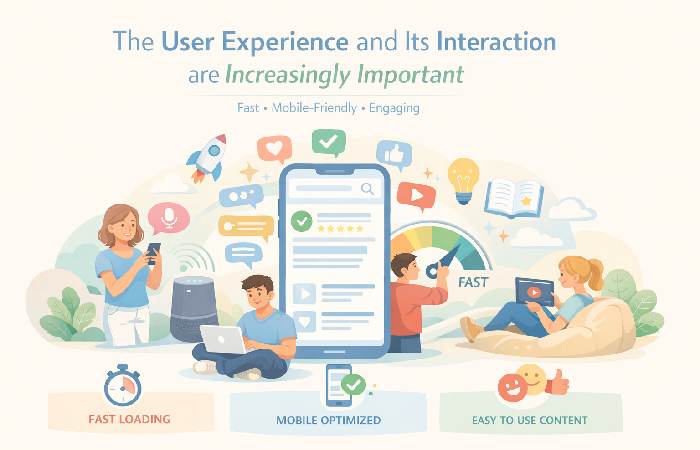
The User Experience and its Interaction are Increasingly Important
Improving user experience can help a business retain visitors and potentially increase its overall web traffic by making the site easier to use and explore.
The first SEO trend is user experience as it is one of the most significant intended goals of Google. Give people what they want and in a most original and quickest manner possible. Conversely, user interaction and page experience metrics will keep acquiring further opportunities.
To appease the user will become more of a determining factor, and aspects like loading speed are the key to proper experience in the site. Conversely, we shall observe the progression of Google Discover and how it is turning to be an essential traffic platform to informational websites.
Artificial Intelligence will be Critical
Artificial intelligence is changing the way people interact with online content. This intelligent algorithm that we all know shows us the things we like the most and facilitates our searches on the Internet.
Now, search appliances do not usually share their technologies and advances.
But it is believed that they will improve the user skill during the search. Factors ranging from click-through rate to page time could be included.
We will have to captivate and engage readers with well-organized and valuable content. It will also make it calmer for users to find you.
More Voice Searches
2022 presents us with significant SEO trends and professionals who design and manage digital marketing and paid media (PPC) strategies. Voice search has come a long way in the tech space, thanks to Google Assistant, Apple Siri, and Amazon Alexa.
According to digitally adept SEO expert María Julieta Gómez, professor of the Master in Digital Marketing, voice search and the increased consumption of multimedia content are two trends (and opportunities) that must be implemented as part of the strategy. More visual allows us to create more visual marketing campaigns.
More and more voice searches. Either directly from the search engine or intelligent speakers such as Echo or Google Home. “This change and trend in search habits require campaigns to be adapted to more semantic phrases and the use of longtail keywords and adding a conversational tone to text ads,” he adds.
Full Mobile Index
“SEO is neither created nor destroyed; it only transforms. Therefore, 2022, in quotes, will not bring anything new or revolutionary but will continue the trends that we have already been talking about in recent years, “says Professor Sergio Castelo.
Castelo believes that it remain expected that during this coming year, the «Mobile-first index» will become the «full mobile index. So for those who are still behind: the mobile user experience becomes essential, and hiding or eliminating surplus texts from the desktop version will remain left behind.
Any website must remain planned with all the information available from mobile devices. On the other hand, as Google has already confirmed, Web Core Vitals will become one more ranking factor. Once again, keep an eye on the entire user experience, load times, and changes on the page since it loads until the user interacts.
Videos are the Future
Another of the SEO trends for 2022 is, without a doubt, videos. Implementing videos in our SEO strategies is very effective. YouTube has ended a billion users, so now is the time to get started if you’re not creating video content.
To have a decent SEO using videos as a helper, you must optimise the name and description of your video channel, always offering the information and resources that are required. Of course, keywords are crucial for your SEO strategy to be foolproof.
Advantages and Disadvantages of Top SEO Trends (2025)
Understanding what is a search engine and how it connects users with relevant information can help small business owners better understand the basics of search visibility.
| SEO Trend | Advantages | Disadvantages / Challenges |
| AI-Driven & Generative SEO (GEO/AEO) | Improves content relevance and intent matching Higher visibility in AI overviews & answer engines Faster optimization insights |
Requires technical knowledge Risk of over-automation & generic content AI results reduce direct website clicks |
| Voice Search Optimization | Captures conversational & long-tail queries Improves local and mobile visibility Enhances accessibility |
Limited keyword data Difficult to track ROI accurately |
| Mobile-First Indexing | Better rankings on mobile SERPs Improved user experience Higher engagement & conversions |
Requires responsive redesign Performance optimization can be costly |
| Core Web Vitals (UX Signals) | Faster websites improve retention Positive ranking signal Enhances brand trust |
Technical fixes need developer support Ongoing monitoring required |
| Zero-Click Search Optimization | Increased brand exposure in SERPs Positions brand as authority Boosts CTR for featured snippets |
Reduced website traffic Lower direct conversions |
| E-E-A-T (Experience, Expertise, Authority, Trust) | Builds long-term SEO credibility Essential for YMYL niches Improves content quality |
Takes time to establish authority Requires expert contributors |
| Visual & Video Search SEO | Higher engagement & visibility Strong presence in Google Images & video carousels Supports voice & AI search |
High production cost Requires optimization skills |
| Local & Hyperlocal SEO | High-intent traffic Strong conversion rates Essential for SMBs |
Limited reach beyond location Dependent on reviews & listings |
| Structured Data / Schema Markup | Enables rich results Improves CTR Helps AI understand content |
Implementation complexity Requires maintenance |
| User-Generated Content (UGC) | Builds trust & authenticity Improves keyword diversity Supports community engagement |
Quality control issues Moderation required |
| Multilingual & International SEO | Expands global reach Improves regional relevanceCompetitive advantage in new markets |
High cost of localization Technical challenges (hreflang, indexing) |
| Sustainable & Ethical SEO | Long-term ranking stability Aligns with search engine guidelines Builds brand reputation |
Slower short-term results Requires consistent effort |
Conclusion
Positioning is becoming more and more complex and simply optimizing the text, adding keywords and meta titles, is behind us. In the current SEO trends and during 2021, we will have to think about topics that range from voice control to the positioning of our videos.