Mobile App Scams: Personal information such as banking information, user names and passwords, UPI information, and more remain often stored in our online accounts and on mobile app scams. And since many individuals now use their smartphones to make purchases through various applications and websites, scammers may take advantage of their vulnerability by bombarding them with calls and texts.
What are Mobile App Scams?
Mobile app scams are fraudulent or fake mobile applications designed to trick users into giving away money, personal information, or device access. These apps often look legitimate but remain created with the intention to deceive, steal, or exploit users.
In simple words:
Mobile app scams are fake or malicious apps that harm users rather than help them.
How Mobile App Scams Work
| Step |
What Scammers Do |
How It Affects Users |
| 1. Create a Fake App |
Design an app that looks like a real or popular app |
Users trust it and download |
| 2. Publish the App |
Upload it to app stores or promote via ads, SMS, or social media |
App appears legitimate |
| 3. Use Attractive Promises |
Offer rewards, discounts, loans, dating matches, or high returns |
Users are tempted to install |
| 4. Ask for Permissions |
Request access to contacts, messages, camera, or storage |
Privacy and data are compromised |
| 5. Trigger the Scam |
Show fake alerts, login screens, or payment requests |
Users unknowingly share details |
| 6. Steal Data or Money |
Collect passwords, card details, OTPs, or auto-debit payments |
Financial loss or identity theft |
| 7. Hide or Repeat Charges |
Activate hidden subscriptions or background transactions |
Continuous money drain |
| 8. Disappear or Update |
App is removed or renamed after complaints |
Scammers avoid detection |
Common Types of Mobile App Scams
| Type of Mobile App Scam |
How It Works |
Main Risk to Users |
| Fake Apps |
Imitate popular apps with similar names or icons |
Data theft or malware |
| Phishing Apps |
Ask users to log in using fake screens |
Stolen passwords & bank details |
| Subscription Trap Apps |
Hide paid subscriptions behind free trials |
Unexpected recurring charges |
| Malware Apps |
Install spyware, adware, or ransomware |
Device damage & data loss |
| Fake Investment / Crypto Apps |
Promise high or guaranteed returns |
Financial fraud |
| Loan & Instant Credit Scam Apps |
Offer quick loans, collect personal data |
Harassment & data misuse |
| Dating Scam Apps |
Use fake profiles to build trust |
Emotional manipulation & money loss |
| Gaming Reward Scams |
Promise cash or prizes for playing games |
Loss of money or personal data |
| QR Code Scam Apps |
Redirect users to fake payment pages |
Unauthorized payments |
| Adware Apps |
Flood device with intrusive ads |
Poor performance & privacy issues |
| Fake Utility Apps |
Claim to boost battery or clean storage |
Malware installation |
| Fake Shopping Apps |
Offer huge discounts on fake products |
Payment fraud |
Warning Signs of Mobile App Scams
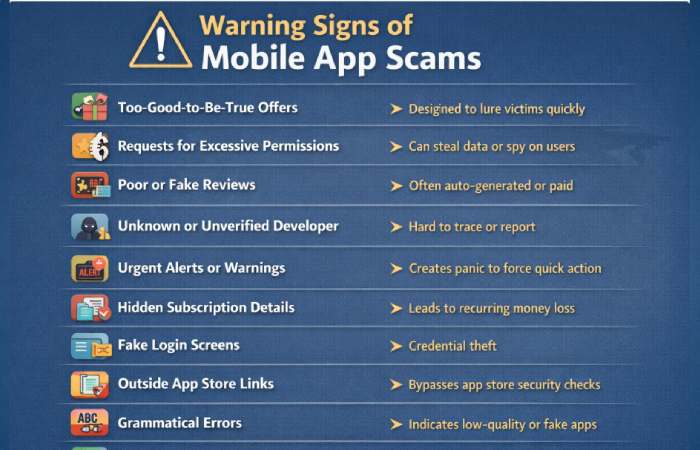
| Warning Sign |
What It Looks Like |
Why It’s Dangerous |
| Too-Good-to-Be-True Offers |
Free money, guaranteed profits, huge discounts |
Designed to lure victims quickly |
| Requests for Excessive Permissions |
Access to contacts, SMS, camera, or storage |
Can steal data or spy on users |
| Poor or Fake Reviews |
Repetitive, overly positive, or broken-English reviews |
Often auto-generated or paid |
| Unknown or Unverified Developer |
No website, no contact info, new developer account |
Hard to trace or report |
| Urgent Alerts or Warnings |
“Account will be blocked today” messages |
Creates panic to force quick action |
| Hidden Subscription Details |
Charges not clearly shown upfront |
Leads to recurring money loss |
| Fake Login Screens |
App asks to re-login to banks or social media |
Credential theft |
| Outside App Store Links |
Redirects to websites or APK downloads |
Bypasses app store security checks |
| Grammatical Errors |
Poor language in app description or messages |
Indicates low-quality or fake apps |
| No Privacy Policy |
Missing or vague privacy policy |
User data may be misused |
How to Protect Yourself from Mobile App Scams
| Protection Step |
What to Do |
Why It Helps |
| Download from Official App Stores |
Use Google Play Store or Apple App Store only |
Reduces risk of malicious apps |
| Check App Reviews & Ratings |
Read recent and detailed user reviews |
Helps spot fake or scam apps |
| Verify the Developer |
Check developer name, website, and contact details |
Confirms app legitimacy |
| Review App Permissions |
Deny unnecessary access (SMS, contacts, camera) |
Prevents data misuse |
| Avoid “Too Good” Offers |
Be skeptical of instant money or guaranteed returns |
Common scam tactic |
| Read Subscription Details |
Check free trials, renewal terms, and pricing |
Prevents hidden charges |
| Keep Your Phone Updated |
Install OS and app updates regularly |
Fixes security vulnerabilities |
| Use Mobile Security Apps |
Install trusted antivirus or security apps |
Detects malware early |
| Don’t Click In-App Ads or Links |
Avoid suspicious pop-ups or redirects |
Prevents phishing attacks |
| Enable App Store Security Features |
Turn on Play Protect / iOS security settings |
Adds an extra safety layer |
| Monitor Bank & App Charges |
Check statements and subscriptions regularly |
Catches fraud quickly |
| Report and Delete Suspicious Apps |
Uninstall and report to the app store |
Protects you and others |
Why Mobile App Scams Are Dangerous
| Danger |
What Happens |
Impact on Users |
| Financial Loss |
Scammers steal money or activate hidden subscriptions |
Direct monetary damage |
| Identity Theft |
Personal details like ID, phone, or email are stolen |
Fraud, fake accounts, long-term risk |
| Data Privacy Breach |
Apps collect contacts, messages, and files |
Loss of personal privacy |
| Banking & Payment Fraud |
Card details, UPI, or OTPs are captured |
Unauthorized transactions |
| Malware Infection |
Spyware or ransomware is installed |
Device damage or lockout |
| Unauthorized Access |
Scammers gain control over apps or accounts |
Loss of digital control |
| Harassment & Blackmail |
Data is misused to threaten users |
Emotional stress and fear |
| Device Performance Issues |
Excessive ads or background activity |
Slow phone, battery drain |
| Loss of Trust |
Users fear downloading new apps |
Reduced digital confidence |
| Legal & Compliance Risks |
Misused data may involve legal issues |
Potential legal trouble |
| Difficulty Recovering Losses |
Scammers disappear quickly |
Low chances of refunds |
Top Mobile App Scams Targeting Users Today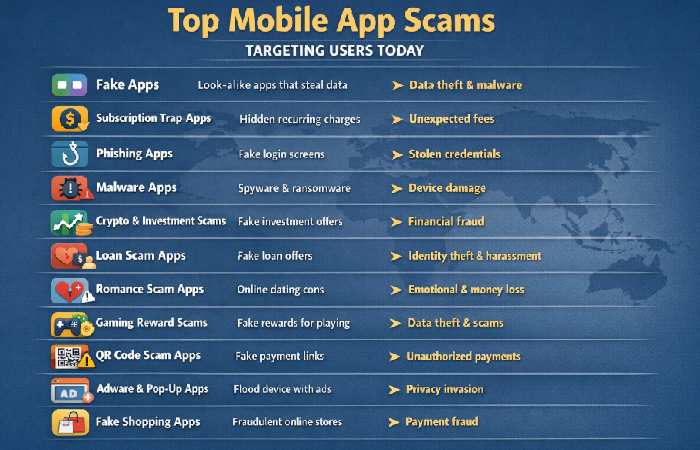
| Scam Type |
How It Works |
Main Risk to Users |
| Fake Apps |
Impersonates popular apps with similar names/icons |
Data theft, malware installation |
| Subscription Trap Apps |
Free to download but charge hidden recurring fees |
Unexpected charges, financial loss |
| Phishing Apps |
Mimic login screens to steal credentials |
Account & identity theft |
| Malware Apps |
Installs spyware, adware, or ransomware |
Privacy invasion & device damage |
| Investment/Crypto Scam Apps |
Promise guaranteed returns, ask for deposits |
Financial fraud & loss |
| Loan & Cash Advance Scams |
Fake loan offers that collect personal info |
Identity theft & harassment |
| Romance Scam Apps |
Build trust then ask for money |
Emotional manipulation & loss |
| Gaming Reward Scams |
Promise prizes or cash for playing |
Personal data abuse, money loss |
| QR Code Scam Apps |
Redirects to fake payment/phisihing pages |
Unauthorized payments |
| Adware & Pop-Up Apps |
Overload with ads or malicious links |
Poor performance & privacy risk |
| Fake Utility Apps |
Claim to boost device performance |
Malware or data harvesting |
| Fake Shopping Apps |
Unrealistic discounts, non-delivery |
Payment fraud & non-receipt |
Mobile App Scams Real Life Examples (Country-wise)
India – Fake Apps, Loan & Fraud Apps
| Mobile App Scam |
How It Was Done |
Impact / Reviews |
| Chain marketing/Investment app scam (“Huge App”) |
Scammer created a fake investment/chain marketing app. Users paid registration fees and later extra “maintenance charges” before the app suddenly shut down. |
Victims lost large sums; cyber police arrested the accused. Reported across rural and urban areas. |
| Fake RTO/Utility app scam |
A fake RTO (traffic challan) app tricked a user into entering details and transferring money — leading to loss of ₹8.68 lakh. |
Single victim loss highlights risk of cloned official app scams. |
| WhatsApp malware scam |
Users were tricked into downloading a fake app via WhatsApp SMS, giving remote device access; ₹85,000 loss through fraudulent purchases. |
Over 575 complaints in Kerala; many victims exploited via compromised accounts. |
United States – APP Scams & Romance App Fraud
| Mobile App Scam |
How It Was Done |
Impact / Reviews |
| APP (Authorised Push Payment) scam cases (online banking fraud) |
Victims were tricked into authorizing payments on mobile banking apps under false pretences. |
U.S. saw over $2 billion in losses in 2023 from APP scams. |
| Romance/dating app investment scam (Bumble) |
A scammer used a dating app to gain trust and convince victim to send money for a “house purchase.” |
One case involved a victim losing $272,000 through wire transfers. |
United Kingdom – APP Fraud via Mobile Payments & Social Platforms
| Mobile App Scam |
How It Was Done |
Impact / Reviews |
| APP fraud (mobile financial transfers) |
Criminals tricked users into sending authorised payments using mobile banking or payment apps. |
Losses reached £450 million+ in 2023; tens of thousands of incidents reported. |
| SMS “smishing” attacks |
Scammers used devices to send fake text messages that led users to fraudulent app links. |
Arrests in Manchester & London; users urged to block unknown messages. |
Brazil – Mobile Banking & Social App Scams
| Mobile App Scam |
How It Was Done |
Impact / Reviews |
| Mobile banking & social engineering fraud |
Scammers used mobile devices and fraud techniques to access bank accounts and make unauthorized transactions. |
~$500 million annually lost due to mobile fraud, especially via banking apps and social engineering. |
| Scams via social/dating platforms + PIX |
Fake profiles on apps like Tinder were used to lure victims and extract money via instant payment (PIX). |
High loss rates reported; Brazilians experience frequent scam contacts. |
Australia & Germany – Malware & SMS/APP Scams (Example)
Australia
| Mobile App Scam |
How It Was Done |
Impact / Reviews |
| FluBot Android malware (also hit Australia) |
Malicious links spread via SMS led to spyware installs that stole data. |
~16,000 reports in Australia during one wave — showing malware’s reach. |
| Romance/dating scam via apps |
Scammers used dating apps to lure and trick victims into investing in fake crypto schemes. |
Victims lost hundreds of dollars; police warnings issued. |
Germany (as a wider European example)
| Mobile App Scam |
How It Was Done |
Impact / Reviews |
| FluBot malware campaigns |
Fake SMS and link campaigns spread malware to German Android phones. |
Targeted attacks also hit Germany alongside other EU countries. |
Final Thought
Mobile app scams are a growing digital threat that can impact anyone—from financial loss to serious privacy and identity risks. As scammers become more sophisticated, awareness and caution are your strongest defenses. Always download apps from trusted sources, question anything that feels too good to be true, and stay alert to warning signs. A few extra minutes of verification can save you from long-term damage. Staying informed isn’t just smart—it’s essential for staying safe in today’s mobile-first world.
Related Reading: Check out our guide on how to choose the right Mobile Payment Apps.