
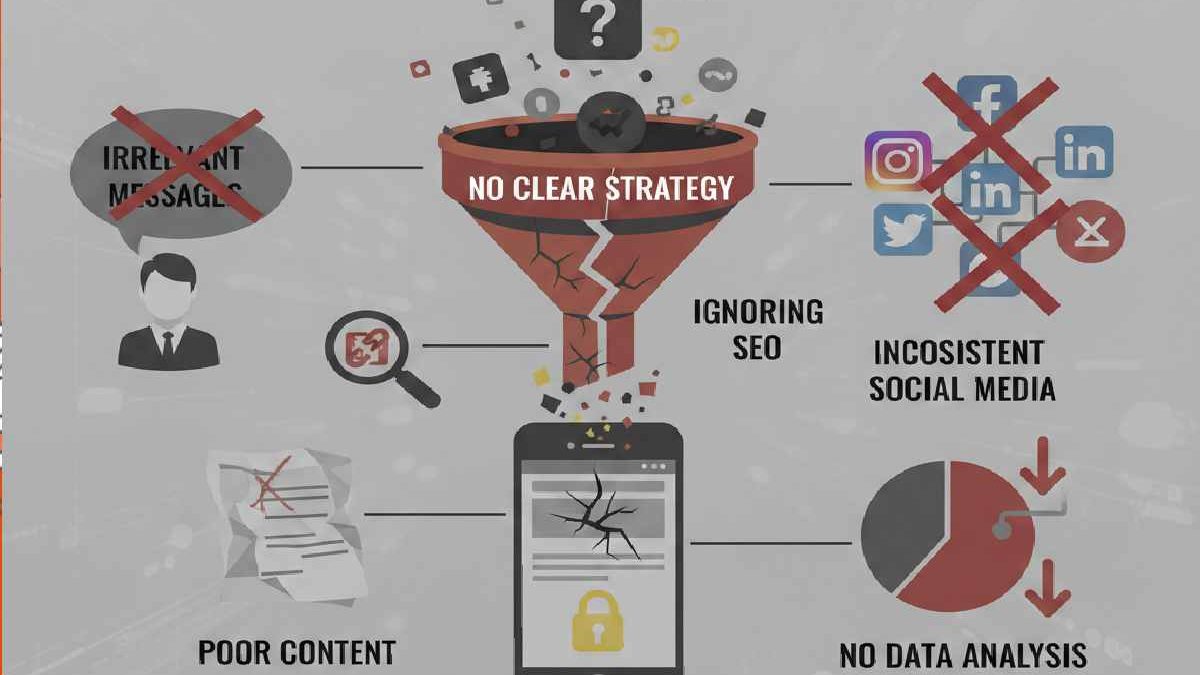
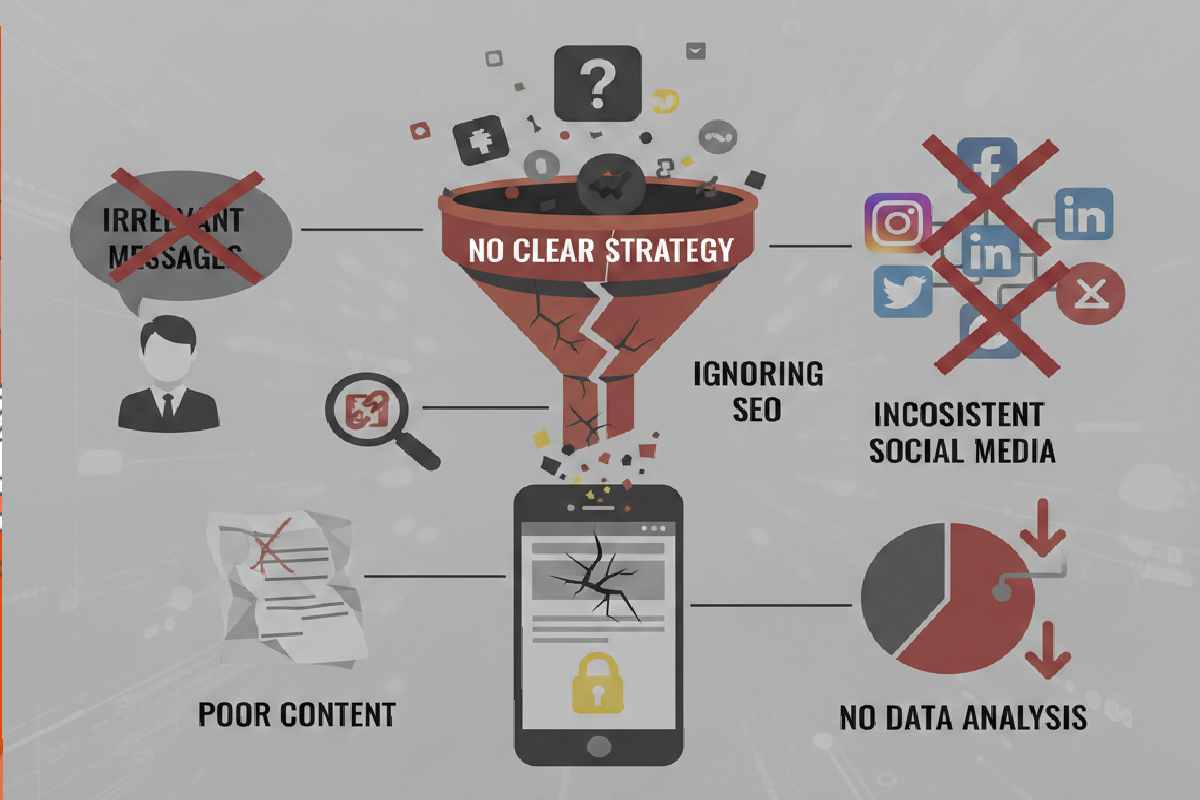
6 Common Digital Marketing Mistakes
In today’s digital world, whether your company’s a tiny startup or a giant brand, one thing still rings true—always. The internet’s a mighty way to get your business or product seen—it links you with people scrolling on their phones or sipping a latte while tapping at their laptop.
Remember that and be sure that you are not missing even a single drop of this tool, similar to a lemon where you try to get the very last bright splash of juice.
Pause for a moment and go through your online marketing plan with a fresh eye – are you following the same routine you always do, going after the most visible clicks instead of real leads who actually call or press the “sign up” button?
If you are, you can fix those mistakes quickly and attract more customers—like a bright sign that flashes in your peripheral vision on a busy street.
Content Marketing
Table of Contents
What is Digital Marketing?
Understanding the advantages of online marketing can help businesses see why digital channels are now essential for reaching customers, tracking performance, and scaling campaigns.
Digital marketing is the process of promoting or marketing products, services, or brand via various online channels, digital techniques and web based channels of interaction with target customers to attract them, interact with them and make them to respond positively and eventually take required action like buying and others. The digital marketing methods use devices such as, search engine, websites, social media networks, mobile apps, mail, advertisement, and analytic tools to target customer base on time.
Unlike traditional marketing, such as television commercials, radio spots, print media and billboard ads, digital marketing enable precise targeting, real-time tracking, measuring and analysis of performance with personalized data for a better conversion and optimization which would make it the most cost effective and scalable form of marketing in 2026.
To put it simply, digital marketing is marketing online, which allows it to be measure, optimized, and scalable continually.
For a broader understanding of the channels, strategies, and techniques involved, explore our complete guide to digital marketing.
Why Digital Marketing is Important in 2026?
Today with more than 5.5 billion people in the world already using internet services and above 90% of the purchase decisions being made online, it would serve the primary driving engine for the success of every business in the digital marketing sector.
Key Reasons Why Digital Marketing Matters:
- Global customer reach
- Cost-effective advertising
- Precise audience targeting
- Real-time performance tracking
- High return on investment (ROI)
- Personalized marketing experiences
- Scalable growth opportunities
Digital Marketing for Manufacturers: Common Mistakes
The unique challenges of manufacturing companies stem from long sales cycles, technical products, and B2B audiences. The table below lists manufacturers’ common digital marketing mistakes and shows how you can fix them.
Digital Marketing Mistakes in Manufacturing
| Common Mistake | Why It Hurts Growth | Better Digital Marketing Approach |
| No SEO-focused website | Limits organic visibility and lead generation | Optimize product pages with industry keywords and technical content |
| Outdated or technical-only content | Confuses non-technical buyers | Create buyer-friendly blogs, FAQs, and guides |
| Ignoring LinkedIn & B2B platforms | Misses decision-makers | Use LinkedIn for thought leadership and lead nurturing |
| Poor mobile optimization | High bounce rates | Build mobile-responsive, fast-loading websites |
| No content for different funnel stages | Leads drop off early | Create awareness, consideration, and decision-stage content |
| Lack of analytics tracking | No performance insights | Use Google Analytics, Search Console, and CRM tools |
| Over-reliance on offline sales | Slows scalability | Combine offline sales with inbound digital marketing |
Global Digital Marketing Budget Waste: Industry Statistics (2026)
Shocking Facts Based on Industry Research:
- 61% of businesses waste 25–40% of their digital marketing budget
- 44% of SMBs fail due to poor marketing ROI tracking
- 72% of startups overspend on ads without conversion tracking
- 55% of B2B companies generate unqualified leads
- 68% of marketers do not optimize landing pages properly
Digital Marketing Mistakes by Business Size
| Business Type | Most Common Mistakes | Impact Level |
| Startups | Over-spending on ads, no SEO | Very High |
| Small Businesses | No strategy, weak website | Very High |
| Mid-sized Companies | Poor automation, no CRO | High |
| Enterprises | Complex funnel leaks, data silos | Medium |
| Manufacturers | Weak content + no inbound | Very High |
Costly Digital Marketing Mistakes & Their Financial Impact (2026 Data)
| Mistake | Monthly Budget Loss | Annual Loss |
| Poor Ad Targeting | $300 – $5,000 | $3,600 – $60,000 |
| No Conversion Tracking | $500 – $8,000 | $6,000 – $96,000 |
| Bad Landing Pages | $400 – $6,500 | $4,800 – $78,000 |
| No SEO Strategy | $600 – $9,000 | $7,200 – $108,000 |
| Wrong Marketing Tools | $200 – $4,000 | $2,400 – $48,000 |
Platform-Wise Digital Marketing Mistakes
| Platform | Common Mistake | Result |
| Google Ads | Broad keyword targeting | High CPC, low ROI |
| Facebook Ads | Wrong audience interest targeting | Low conversion |
| No funnel structure | Engagement but no sales | |
| No thought leadership | Low B2B leads | |
| YouTube | No retargeting | Low ROI |
| No segmentation | Poor open rates | |
| SEO | Keyword stuffing | Ranking penalties |
Why Digital Marketing Fails Without Strategy
A strong digital strategy should also support brand digitization, helping businesses create a consistent online presence across websites, social media, and other digital channels.
Many businesses invest in ads or social media without a structured plan. Successful digital marketing requires:
- Clear buyer personas
- Keyword-driven content strategy
- Conversion-optimized landing pages
- Consistent performance tracking
Without these, even high budgets fail to deliver measurable ROI.
Marketing Budget Allocation Errors
Ideal vs Wrong Allocation
| Channel | Wrong Budget % | Ideal Budget % |
| Paid Ads | 70% | 35% |
| SEO | 5% | 30% |
| CRO | 0% | 15% |
| Content | 10% | 15% |
| Analytics | 0% | 5% |
Funnel-Level Mistakes Most Businesses Make
| Funnel Stage | Common Mistake | Fix |
| Awareness | Only paid ads | SEO + content marketing |
| Consideration | Weak blogs | Case studies + demos |
| Conversion | Bad landing UX | CRO + A/B testing |
| Retention | No email flows | Automation & CRM |
| Upsell | No remarketing | Retargeting campaigns |
High-Converting Marketing Funnel Cost (2026)
| Funnel Stage | Avg Cost | ROI Potential |
| Traffic Acquisition | $200 – $1,500 | Medium |
| Lead Magnet | $50 – $400 | High |
| Landing Page | $100 – $1,000 | Very High |
| Email Automation | $40 – $300 | Very High |
| Retargeting | $100 – $800 | High |
6 Common Digital Marketing Mistakes
A well-defined marketing plan should be supported by effective brand strategy development so that messaging, positioning, and customer communication remain consistent across digital channels.
Mistake #1: No Clear Digital Marketing Strategy
A clear digital marketing strategy is the foundation of successful online growth. Without it, businesses often waste budget, post inconsistently, and fail to measure real results. This mistake usually shows up as random activities with no direction, no targets, and no accountability.
What a Digital Marketing Strategy Includes vs Not Having One
| Without Strategy | With Strategy |
| No clear goals or objectives | Defined goals (leads, sales, brand awareness) |
| Random posting on social media | Planned content calendar aligned with goals |
| No defined target audience | Clearly defined audience & buyer personas |
| No KPIs or benchmarks | Measurable KPIs (CTR, CAC, ROI, conversions) |
| Short-term, reactive actions | Long-term, scalable growth plan |
| Wasted budget and effort | Optimized budget allocation |
| Inconsistent messaging | Consistent brand voice & messaging |
Mistake #2: Ignoring Target Audience & Buyer Personas
Understanding the Audience vs Guesswork
| Wrong Approach | Correct Approach |
| Marketing to “everyone” | Targeting specific audience segments |
| Assuming customer needs | Research-based audience insights |
| No demographic or behavior analysis | Uses age, location, behavior & intent |
| Generic content and ads | Personalized content & messaging |
| Low engagement rates | Higher engagement and conversions |
| Irrelevant ad targeting | Precision targeting using personas |
| Poor customer experience | Customer-centric marketing |
Mistake #3: Poor Website & Landing Page Optimization
Website Issues and Their Business Impact
| Website Mistake | Business Impact |
| Slow page loading speed | High bounce rate |
| Poor user experience (UX) | Low engagement |
| No clear CTA (Call-to-Action) | Lost leads and sales |
| Mobile-unfriendly design | Missed mobile traffic |
| Confusing navigation | Low conversion rate |
| Weak landing pages | Poor campaign ROI |
| Unoptimized forms | Fewer lead submissions |
Mistake #4: Focusing Only on Traffic, Not Conversions
Traffic vs Conversion-Focused Marketing
| Metric | Traffic Focus | Conversion Focus |
| Primary Goal | Increase visitors | Increase leads/sales |
| Measurement | Page views, sessions | Conversion rate, revenue |
| CTA Usage | Weak or missing | Clear, optimized CTAs |
| Funnel Design | No funnel | Structured conversion funnel |
| ROI | Low or unclear | Measurable and scalable |
| User Intent | Ignored | Prioritized |
| CRO Efforts | None | Continuous testing & optimization |
Mistake #5: Neglecting SEO & Long-Term Growth
Paid Ads Only vs SEO + Paid Ads
| Paid Ads Only | SEO + Paid Ads |
| Immediate but temporary traffic | Sustainable long-term traffic |
| High ongoing costs | Lower long-term acquisition cost |
| Traffic stops when ads stop | Organic traffic continues |
| No content authority | Builds brand authority |
| Limited keyword reach | Broad keyword visibility |
| Short-term wins | Compounding growth |
| Dependent on ad platforms | Balanced traffic sources |
Mistake #6: Not Tracking, Analyzing, or Optimizing Data
Key Metrics and Why They Matter
| Tracked Metric | Why It Matters |
| Website Traffic | Measures reach and awareness |
| Conversion Rate | Shows campaign effectiveness |
| Cost Per Lead (CPL) | Controls marketing spend |
| Customer Acquisition Cost (CAC) | Determines profitability |
| Bounce Rate | Indicates UX and content quality |
| ROI | Measures success of campaigns |
| Engagement Metrics | Shows audience interest |
| Funnel Drop-Off | Identifies optimization points |
Impact of These Digital Marketing Mistakes
| Mistake Impact | Business Outcome |
| Wasted marketing budget | Low ROI |
| Poor lead quality | Low sales conversion |
| Inconsistent branding | Weak brand authority |
| No performance tracking | Blind decision-making |
| Missed optimization | Slower growth |
| Ineffective campaigns | Loss of competitive edge |
10 Digital Marketing Mistakes That Are Killing Your ROI
| # | Digital Marketing Mistake | Why It Kills ROI | How to Fix It | Trusted Resource |
| 1 | No Clear Marketing Strategy | Random efforts, wasted spend, no direction | Build structured funnel + SMART goals | https://blog.hubspot.com/marketing/marketing-plan-guide |
| 2 | Ignoring Target Audience | Low engagement, wrong leads, low conversion | Create buyer personas + intent mapping | https://www.semrush.com/blog/buyer-persona/ |
| 3 | Poor Website UX & Speed | High bounce rate, low conversions | Improve Core Web Vitals + UX design | https://developers.google.com/speed/pagespeed/insights |
| 4 | Focusing Only on Traffic | High visits, no sales | Track conversions + CRO optimization | https://cxl.com/blog/conversion-rate-optimization/ |
| 5 | Neglecting SEO | Dependence on paid ads, high acquisition cost | Build SEO + content marketing strategy | https://ahrefs.com/blog/seo-basics/ |
| 6 | Weak Content Strategy | Low trust, poor rankings | Create helpful, long-form, intent-based content | https://contentmarketinginstitute.com/what-is-content-marketing/ |
| 7 | No Conversion Rate Optimization (CRO) | Lost sales opportunities | Run A/B tests + funnel optimization | https://optimizely.com/optimization-glossary/conversion-rate-optimization/ |
| 8 | Poor Ad Targeting | High CPC, low ROAS | Use audience segmentation + remarketing | https://www.wordstream.com/blog/ws/2019/01/09/facebook-ad-targeting |
| 9 | No Analytics & Tracking | Blind decision-making | Implement GA4 + funnel dashboards | https://support.google.com/analytics/answer/10089681 |
| 10 | No Lead Nurturing & Follow-up | Cold leads, lost deals | Build email + retargeting funnels | https://blog.hubspot.com/marketing/lead-nurturing-campaigns |
ROI Impact Breakdown (2026 Data)
| Mistake Type | Avg ROI Loss |
| No Strategy | 30–45% |
| Poor SEO | 25–40% |
| Bad Funnels | 35–50% |
| Poor Ads | 20–38% |
| No Tracking | 40–60% |
Cost Impact of These Mistakes (Monthly)
| Mistake | Avg Monthly Loss |
| No SEO | ₹12,000 – ₹75,000 |
| Poor Ads | ₹8,000 – ₹60,000 |
| Bad UX | ₹6,000 – ₹50,000 |
| No Analytics | ₹10,000 – ₹80,000 |
Common Consequences of These Mistakes
Maintaining a strong company online reputation is also important because inconsistent messaging, poor customer experiences, and neglected digital channels can affect how potential customers perceive a business.
| Area Affected | Result |
| Marketing Budget | Wasted spend |
| Lead Quality | Poor-fit prospects |
| Sales Funnel | Low conversion rates |
| Brand Authority | Weak trust |
| Growth | Stagnation |
How High-ROI Brands Avoid These Mistakes
| Best Practice | What They Do Differently |
| Strategy First | Clear roadmap & measurable goals |
| Data-Driven | Decisions based on analytics |
| User-Centric | Focus on experience & value |
| Optimization Mindset | Continuous testing |
| Long-Term Vision | Balance paid + organic growth |
How to Avoid Digital Marketing Mistakes in 2026
Businesses that lack the time or expertise to manage campaigns internally may consider working with a digital marketing agency for strategy, execution, analytics, and ongoing optimization.
To stay competitive, companies—especially manufacturers—should:
- Focus on SEO-driven content marketing
- Invest in marketing automation and CRM integration
- Use data analytics to refine campaigns
- Build trust through case studies and educational content
- Align marketing goals with sales teams
| Best Practice | How It Helps |
| Build a structured marketing plan | Aligns goals, channels, and KPIs |
| Define target audience & personas | Improves relevance & engagement |
| Optimize website & landing pages | Increases conversions |
| Focus on CRO | Turns traffic into revenue |
| Balance SEO & paid ads | Ensures long-term growth |
| Use analytics tools (GA4, CRM) | Enables data-driven decisions |
| Test, analyze, optimize regularly | Continuous performance improvement |
| Hire experts or agencies | Saves time and improves ROI |
Final Thoughts
Because using digital marketing to help grow your business is probably not something that would surprise you. It is only helpful when performed in the right manner, which would surprise you.