



Fahmeena creates practical and reader-focused content across technology, digital marketing, business and emerging digital trends.

Sameena reviews published content for clarity, factual presentation, consistency and overall reader usefulness.
In today’s digital-first economy, technology is no longer just a support function—it is a critical driver of business success. Organizations across industries rely on advanced technologies such as cloud computing, artificial intelligence, data analytics, and cybersecurity systems to stay competitive and deliver better customer experiences.
As technology becomes more complex and essential to business operations, companies need strong leadership to guide their IT strategies. This is where the role of a Chief Information Officer (CIO) becomes crucial.
A CIO is a senior executive responsible for overseeing an organization’s information technology strategy, infrastructure, and digital transformation initiatives. Their role goes beyond managing IT systems; they align technology investments with business goals to improve efficiency, innovation, and long-term growth. By evaluating emerging technologies, managing digital risks, and optimizing IT resources, a CIO ensures that technology supports the company’s strategic vision.
Business Technology
Table of Contents
What Exactly is a CIO?

A CIO is a skilled professional who leads an organization’s IT strategy. In other words, they are the highest-ranking member in the information technology department.
CIO studies available technology and assists firms in implementing or adapting such technologies. As a result, a CIO is a specialist who manages the resources of the information technology department. They also oversee or supervise other IT department employees.
These people are significant in any business. Because technology evolves rapidly, the use of technology from a few months ago may no longer be relevant today. As a result, any organization that lags behind new technology may find it challenging to remain relevant or competitive.
Chief Information Officer
A Chief Information Officer (CIO) is a senior executive responsible for managing and leading a company’s information technology strategy. The CIO oversees IT infrastructure, digital transformation, cybersecurity, data management, and technology investments.
In simple terms, the CIO connects business strategy with technology execution.
Core Responsibilities of a CIO
| Responsibility | Description | Business Impact |
| IT Strategy | Align tech with goals | Better decision-making |
| Digital Transformation | Adopt new technologies | Innovation |
| Cybersecurity | Protect systems & data | Risk reduction |
| Data Management | Handle data systems | Business insights |
| Infrastructure | Servers, cloud, networks | Operational stability |
| Vendor Management | Manage tech partners | Cost efficiency |
| Compliance | Follow regulations | Legal safety |
Skills Required for a Successful CIO
A modern CIO needs both technical and leadership skills. They must understand technology deeply while also thinking like a business leader.
| Skill Type | Examples |
| Technical | Cloud, cybersecurity, AI, data |
| Business | Strategy, finance, operations |
| Leadership | Team management |
| Communication | Stakeholder alignment |
| Risk Management | Disaster recovery |
CIO vs CTO vs COO
Many companies confuse CIO with other executive roles. Each has a different focus.
| Role | Primary Focus |
| CIO | Internal systems & IT strategy |
| CTO | Product & engineering |
| COO | Daily business operations |
Business insight:
- CIO = Technology for business efficiency
- CTO = Technology for products
- COO = Business execution
6 Advantages of Hiring a CIO for Your Company
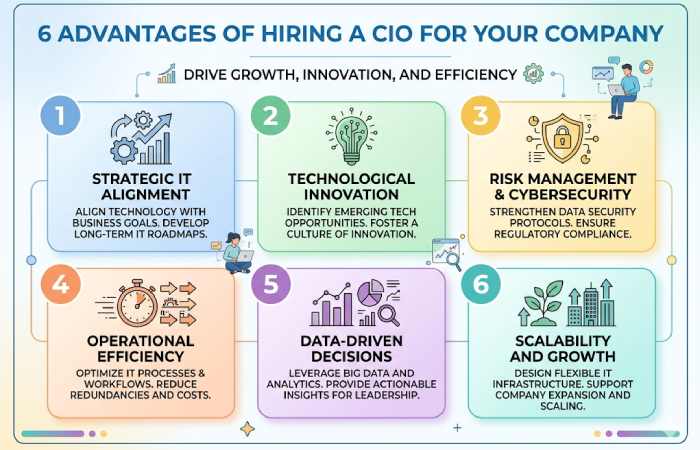
One way to substantially change how an organization handles technology, data, and digital strategy is to appoint a Chief Information Officer (CIO). With increased use of digital systems, cloud computing and cybersecurity infrastructure, there is a need to have a special executive to manage these components. A CIO manages to make sure investments in technology are in line with business objectives that are long term but remain efficient, secure and innovative.
Strategic Technology Planning
The second greatest advantage of a CIO is the opportunity to match technology to business strategy. In the absence of a good leadership, organizations can end up investing in systems or tools that do not bring about actual value.
A CIO analyses objectives of the organization and develops an IT roadmap which helps in promoting growth, efficiency, and innovation within the organization.
Key Benefits
- Fits the IT strategy with the business goals.
- Finds productivity enhancing technologies.
- Gets rid of redundant or obsolete systems.
- Favors long term digital transformation.
Stronger Cybersecurity and Risk Management
A CIO can also help establish the systems and policies needed for online security for businesses, including security monitoring, access controls, data protection, and risk management.
There is a growing threat of cybersecurity incidents annually and data breaches have a potential of leading to severe financial and reputational losses. A CIO is a very vital person in safeguarding the digital resource of an organization.
They apply security policies, check threats as well as make sure that systems are secure and within regulations.
Security Enhancements under CIOs:
- Network and data protection
- CCTV surveillance.
- Disaster recovery planning
- Awareness of security program among employees.
- The adherence to laws on data protection.
Companies that have good leadership in cyberssecurity usually have reduced chances of cyber attacks as well as better response to security attacks.
Improved IT Efficiency and System Performance
Numerous enterprises have difficulties with sluggish systems, old infrastructure or networked software platforms. CIO examines the whole ecosystem of IT and streamlines it by enhancing efficiency through infrastructure optimization and workflow automation.
| Area | Improvement |
| IT Infrastructure | Modernized servers and cloud systems |
| Software Systems | Integrated platforms |
| Business Processes | Automated workflows |
| Support Services | Faster response times |
This streamlining saves time and increases the efficiency of the employees within the organization.
Better Data Management and Business Insights
Information has become one of the most useful assets of contemporary organizations. A CIO makes sure that data is gathered, archived and examined efficiently to enable companies to make sound judgments. CIOs can assist organizations to convert unprocessed data into useful information by integrating data analytics tools and business intelligence platforms.
Advantages of Better Data Management.
- Data-driven decision making
- Better planning and forecasting.
- Customer behavior insights
- Interdepartmental performance monitoring.
Companies that make good use of data will have a better chance of excelling in rapidly evolving markets.
Cost Optimization and Technology Budget Control.
The investments made in technology may easily run out of control when it is not strategically handled. A CIO assists organizations to manage the IT budgets efficiently, and to remove the redundant costs.
They compare expenditure in hardware, software and IT manpower to guarantee high returns on investment.
Popular Cost Reduction Measures:
- Moving software subscriptions.
- Migration to cost-effective cloud solutions.
- Reducing duplicate IT tools
- Making vendor contracts better.
When the IT budget is controlled, organizations will be able to allocate more funds towards innovation and enterprise development.
Driving Innovation and Digital Transformation
As part of digital transformation, CIOs can evaluate emerging technologies such as artificial intelligence and identify practical opportunities for growing your business with AI, from automation and customer experience to data-driven decision-making.
Businesses that desire to be relevant in today markets have to be digitalized. A CIO is a leader of innovation activities and he determines new technologies that are capable of enhancing products, services and operations.
Such technologies can be:
- Artificial Intelligence (AI)
- Cloud computing
- Automation and robotics
- Internet of Things (IoT)
- Advanced data analytics
CIOs help companies to be ahead of their competitors and to react fast to changes in the market by the adoption of new technologies in a strategic way.
Country-Wise CIO Consulting Companies
For organizations operating in the Gulf region, understanding local technology infrastructure, cybersecurity requirements, cloud adoption, and digital transformation priorities is equally important. Businesses can also explore how IT for business in Saudi Arabia supports efficiency, security, and long-term growth.
United States CIO Consulting Firms
| Company | Service Type | Estimated Price | Resource |
| Accenture | Enterprise CIO Consulting | $20,000 – $200,000/project | https://www.accenture.com |
| Deloitte Technology Consulting | CIO Advisory | $25,000 – $300,000/project | https://www.deloitte.com |
| Gartner Consulting | CIO Strategy | $10,000 – $150,000 | https://www.gartner.com |
| IBM Consulting | Digital Transformation | $50,000 – $500,000 | https://www.ibm.com |
| Cognizant | IT Strategy Services | $20,000 – $250,000 | https://www.cognizant.com |
India CIO Consulting Firms
| Company | Service | Estimated Price | Resource |
| TCS | Enterprise IT Strategy | ₹10L – ₹2Cr | https://www.tcs.com |
| Infosys Consulting | Digital transformation | ₹20L – ₹3Cr | https://www.infosys.com |
| Wipro Digital | CIO advisory | ₹10L – ₹1Cr | https://www.wipro.com |
| Tech Mahindra | IT leadership consulting | ₹8L – ₹80L | https://www.techmahindra.com |
| VirtualCIO India | Virtual CIO services | ₹1L – ₹6L per month | https://www.virtualcio.in |
United Kingdom CIO Consulting Firms
| Company | Service | Estimated Price | Resource |
| Capgemini | CIO strategy consulting | £20,000 – £200,000 | https://www.capgemini.com |
| KPMG Technology Advisory | IT transformation | £25,000 – £250,000 | https://www.kpmg.com |
| PwC Technology Consulting | CIO services | £30,000 – £300,000 | https://www.pwc.com |
| Atos Consulting | Enterprise IT strategy | £20,000 – £150,000 | https://atos.net |
| PA Consulting | Digital strategy | £15,000 – £120,000 | https://www.paconsulting.com |
Canada CIO Consulting Firms
| Company | Service | Estimated Price | Resource |
| CGI Group | IT consulting | CAD $20K – $250K | https://www.cgi.com |
| Deloitte Canada | CIO advisory | CAD $30K – $300K | https://www2.deloitte.com |
| Accenture Canada | Digital transformation | CAD $40K – $400K | https://www.accenture.com |
| IBM Canada | Enterprise consulting | CAD $50K – $500K | https://www.ibm.com |
| Softchoice | CIO consulting | CAD $15K – $120K | https://www.softchoice.com |
Australia CIO Consulting Firms
| Company | Service | Estimated Price | Resource |
| Telstra Purple | Digital consulting | AUD $20K – $200K | https://www.telstrapurple.com |
| Accenture Australia | IT strategy | AUD $30K – $350K | https://www.accenture.com |
| Deloitte Australia | CIO advisory | AUD $25K – $300K | https://www2.deloitte.com |
| DXC Technology | Technology consulting | AUD $20K – $250K | https://dxc.com |
| Data#3 | CIO consulting | AUD $15K – $150K | https://www.data3.com |
5 Strategic Signs It’s Time to Hire Your First CIO
Hiring your first CIO is a major milestone. It usually happens when technology becomes too important to be managed only by IT staff or external vendors. A CIO is needed when technology decisions start affecting revenue, compliance, security, and long-term growth.
Many companies delay hiring a CIO and end up facing system failures, security risks, and poor digital strategy. The right time to hire a CIO is when your business begins to scale and technology becomes a core business function, not just a support role.
Strategic Triggers That Signal the Need for a CIO
| Sign | What It Means for Your Business |
| Digital Transformation | You’re moving to cloud, AI, automation |
| Complex Security Regulations | GDPR, data privacy, compliance |
| Scaling to New Markets | Multi-region systems needed |
| Rapid Business Growth | IT can’t keep up |
| High Technology Spend | No strategic oversight |
Business insight:
If technology decisions impact your customers, revenue, or legal compliance — you need a CIO.
How to Hire a CIO: A Step-by-Step Guide
Hiring a CIO is not just filling a role — it’s hiring a strategic partner. A poorly chosen CIO can slow growth, while the right one can transform your entire business. The hiring process should focus on both technical expertise and business leadership.
Step-by-Step CIO Hiring Process
| Step | Purpose |
| Define Business Needs | Understand what you expect from CIO |
| Create Job Description | Strategic, not just technical |
| Choose Hiring Channel | LinkedIn, executive recruiters |
| Interview Process | Assess leadership + vision |
| Final Selection | Cultural & strategic fit |
| Onboarding Plan | First 90-day roadmap |
Key Interview Questions for CIO Candidates
| Question | What You’re Testing |
| How do you align IT with business goals? | Strategic thinking |
| How do you handle cybersecurity? | Risk management |
| Describe a digital transformation you led | Experience |
| How do you manage IT budgets? | Financial skills |
First 90 Days Success Plan
| Phase | Focus |
| 0–30 Days | Audit systems |
| 30–60 Days | Build IT roadmap |
| 60–90 Days | Implement quick wins |
Business insight:
A CIO should start with listening and auditing, not changing everything immediately.
How a CIO Can Navigate Technology and Build Trust in Recruitment
In modern companies, recruitment heavily depends on technology — from ATS systems to AI screening tools and data-driven hiring platforms. A CIO plays a key role in ensuring that these technologies are secure, ethical, and trusted.
A CIO builds trust by:
- Choosing transparent HR tech tools
- Protecting candidate data
- Ensuring fair AI usage
- Improving hiring efficiency
CIO’s Role in Tech-Driven Recruitment
| Area | CIO Contribution |
| Applicant Tracking | System optimization |
| Data Privacy | Compliance |
| AI Hiring Tools | Ethical use |
| Automation | Faster hiring |
| Analytics | Better decisions |
Business insight:
When candidates trust your hiring systems, your employer brand improves.
Cultural Change Agent: The CIO’s Critical Role
The CIO is not just a technology leader — they are a cultural change agent. They influence how employees work, communicate, collaborate, and adapt to change.
Modern CIOs lead:
- Remote work systems
- Digital collaboration tools
- Data-driven decision-making
- Innovation culture
They help employees shift from manual processes to smart digital workflows.
CIO as a Change Leader
| Change Area | CIO Impact |
| Work Culture | Digital mindset |
| Collaboration | Tools like Slack, Teams |
| Innovation | AI & automation |
| Learning | Tech upskilling |
| Agility | Faster operations |
Business insight:
The best CIOs don’t just manage systems — they transform how people work.
Top 10 CIO Tools & Platforms
| Tool / Platform | Primary Use | Key Features | Estimated Price | Resource Link |
| ServiceNow | IT Service Management (ITSM) | Incident management, workflow automation, asset tracking | $100 – $150 per user/month | https://www.servicenow.com |
| Splunk | Data Analytics & Security Monitoring | Real-time log analysis, threat detection, observability | $150 – $200 per GB/day | https://www.splunk.com |
| Microsoft Power BI | Business Intelligence & Analytics | Interactive dashboards, AI insights, data visualization | $10 – $20 per user/month | https://powerbi.microsoft.com |
| VMware | Cloud Infrastructure Management | Virtualization, hybrid cloud, container platforms | $995+ per CPU license | https://www.vmware.com |
| Tableau | Data Visualization & BI | Advanced analytics dashboards, predictive insights | $70 – $75 per user/month | https://www.tableau.com |
| UiPath | Automation (RPA) | AI automation, workflow bots, process mining | $420 – $1,900 per month | https://www.uipath.com |
| Atlassian | Project & DevOps Management | Jira, Confluence, DevOps pipelines | $7 – $14 per user/month | https://www.atlassian.com |
| ManageEngine | IT Operations Management | Network monitoring, asset management, helpdesk | $95 – $1,195 per year | https://www.manageengine.com |
| FusionReactor | Application Monitoring | Java performance monitoring, observability | $49 – $899 per month | — |
| ManageEngine Site24x7 | Infrastructure & Cloud Monitoring | Server monitoring, AI anomaly detection, DevOps monitoring | $9 – $625 per month | https://www.site24x7.com |
Common Challenges Faced by CIOs
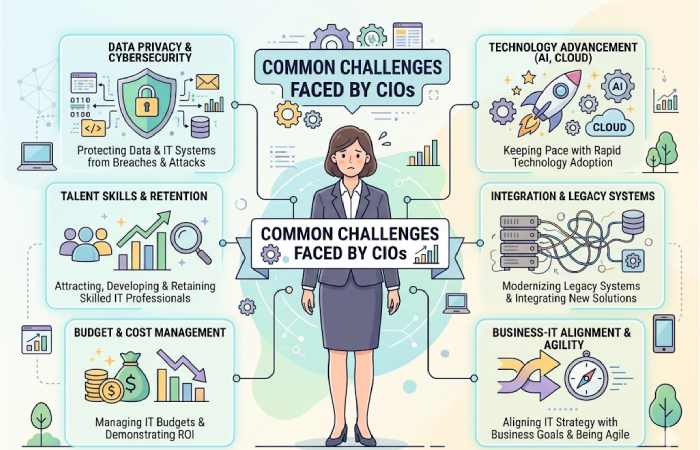
Even experienced CIOs face strategic obstacles.
Major CIO Challenges
- Legacy infrastructure
- cybersecurity threats
- talent shortages
- cloud migration complexity
- regulatory compliance
- digital transformation resistance
Organizations that fail to address these challenges risk losing their competitive advantage.
Future of the CIO Role (2025–2035)
The CIO role will continue evolving as organizations become more technology-driven.
Future CIO responsibilities will include:
- AI governance
- digital ecosystems
- platform strategy
- data monetization
- automation leadership
- sustainability technology
The CIO is expected to become one of the most influential executives in business strategy.
Conclusion
Hiring a CIO is no longer optional for organizations that want to stay competitive in the digital economy. From cybersecurity to digital transformation, CIOs ensure that technology investments translate into real business value.
Whether through full-time leadership, fractional executives, or virtual CIO services, companies must embrace strategic technology leadership to drive innovation, security, and growth.
Fahmeena Begum is a Digital Marketing & Technology Writer at SlashdotBlog with 3+ years of writing experience. Her work covers digital marketing, technology, business, software, artificial intelligence and emerging digital trends.
View Author Profile →
Sameena Begum is a Technology & Digital Content Reviewer with 8 years of experience. Her review work focuses on editorial clarity, factual presentation, readability, consistency and reader usefulness.
View Reviewer Profile →