
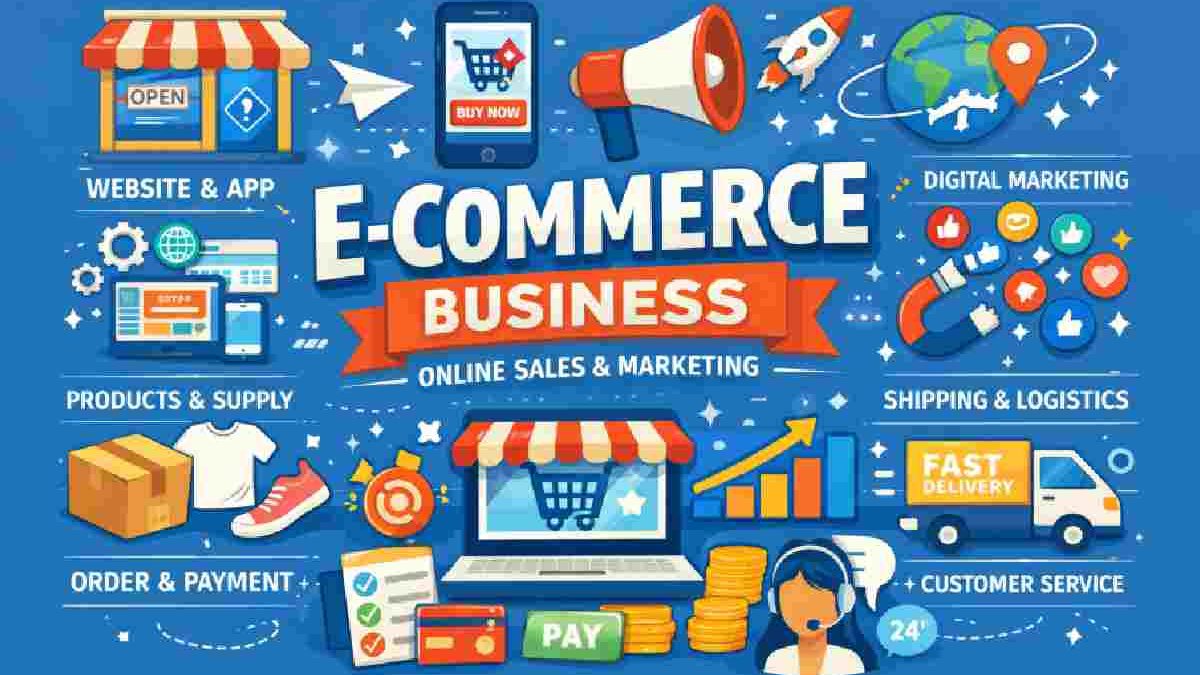

Ecommerce Business is suddenly a reality for millions of businesses that may not have had online sales in their business before COVID-19.
In the majority of the countries, consumers have been reduction in the expenditure of their purchases as consumers have lost their hopes in improving the economy. Even though one of the categories is groceries, home supplies, personal care, and entertainment, consumers are intending to maintain their spending.
Table of Contents
What Is an Ecommerce Business?
A business based on ecommerce operates through websites, mobile applications, or online commodities to transact business. It is all digital, selection of products, payment, and after sales.
Examples include:
- Online shopping websites (Amazon, Flipkart)
- Brand-owned online stores
- Digital service platforms (online courses, software)
- Subscription-based businesses
How Does an Ecommerce Business Work?
- Product Listing – Products or services are displayed online with prices and details
- Customer Order – Customers choose items and add them to a cart
- Online Payment – Payments are made via UPI, cards, wallets, or net banking
- Order Processing – The seller confirms and prepares the order
- Delivery or Access – Physical products are shipped; digital products are delivered online
- Customer Support – Returns, refunds, and queries are handled digitally
Types of Ecommerce Business Models
| Type | Description |
| B2C (Business to Consumer) | Businesses sell directly to customers |
| B2B (Business to Business) | Businesses sell to other businesses |
| C2C (Consumer to Consumer) | Individuals sell to other individuals |
| C2B (Consumer to Business) | Individuals sell services to companies |
How to Start an eCommerce Business
| Step No. | Step | What to Do | Tools / Examples | Outcome |
| 1 | Choose a Niche | Identify products with demand and low competition | Google Trends, Amazon, Flipkart | Clear product focus |
| 2 | Market Research | Analyze competitors, pricing, and customer needs | SEMrush, SimilarWeb | Validated idea |
| 3 | Business Model | Decide how you’ll sell | Dropshipping, Private Label, Wholesale | Scalable structure |
| 4 | Register Business | Choose name, domain, and legal structure | Shopify, GoDaddy | Legal identity |
| 5 | Source Products | Find reliable suppliers | Alibaba, IndiaMART, Local vendors | Product inventory |
| 6 | Build Website | Create online store | Shopify, WooCommerce | Live eCommerce site |
| 7 | Set Up Payments | Enable online payments | Razorpay, Stripe, PayPal | Smooth checkout |
| 8 | Shipping & Logistics | Arrange delivery partners | Shiprocket, Delhivery | Order fulfillment |
| 9 | Product Listing | Add SEO-optimized product pages | Canva, ChatGPT | Higher visibility |
| 10 | Marketing Setup | Promote your store | Google Ads, Instagram, Email | Traffic & leads |
| 11 | Launch Store | Test and go live | Test orders & UX | First sales |
| 12 | Customer Support | Set up support channels | WhatsApp Business, Chatbots | Customer trust |
| 13 | Track & Optimize | Analyze performance | Google Analytics | Business growth |
Estimated Cost to Start (Quick View)
| Expense | Approx Cost |
| Domain & Hosting | $20–$100/year |
| Website Platform | $0–$39/month |
| Marketing | $100–$500/month |
| Inventory (optional) | Varies |
| Payment Gateway | Transaction-based |
Build Trust and Take Care of the Relationship with Customers
This blog has already talked about a customer-centric company and how important it is to optimise the shopping experience and generate more revenue. To achieve this, a fundamental component that must be at the base of any customer-centric company is to gain the trust of your customers.
In a highly competitive online environment, customer trust is a differentiating factor. which has always been in the offline world, but now it also reaches the online world. All the departments of your company must align and work to connect in a personal and authentic way with each client.
Build Trust and Take Care of Customer Relationships
| Strategy | What It Means | How to Implement | Trust-Building Impact |
| Transparency | Be open about pricing, policies, and processes | Clear FAQs, honest product pages | Reduces skepticism |
| Consistent Communication | Stay in touch without spamming | Email updates, order notifications | Builds reliability |
| Personalization | Treat customers as individuals | Personalized emails, recommendations | Increases emotional connection |
| Quality Assurance | Deliver what you promise | Product testing, service SLAs | Strengthens credibility |
| Responsive Support | Solve issues quickly | Live chat, fast email response | Builds confidence |
| Data Privacy & Security | Protect customer data | Secure payment gateways, GDPR compliance | Earns long-term trust |
| Fair Pricing | No hidden charges | Transparent checkout | Enhances brand integrity |
| Customer Feedback | Listen and act on feedback | Surveys, reviews, feedback loops | Shows customers they matter |
| Loyalty Programs | Reward long-term customers | Points, discounts, exclusive perks | Encourages retention |
| Human Touch | Show empathy in interactions | Personalized responses, apologies | Deepens relationships |
Customer Relationship Care: Short vs Long Term
| Timeframe | Focus Area | Result |
| Short-Term | Fast responses & issue resolution | Immediate satisfaction |
| Mid-Term | Consistent service quality | Repeat purchases |
| Long-Term | Trust & emotional loyalty | Brand advocacy |
Key Metrics to Measure Trust & Relationships
| Metric | What It Indicates |
| Customer Satisfaction (CSAT) | Immediate experience quality |
| Net Promoter Score (NPS) | Willingness to recommend |
| Customer Retention Rate | Loyalty strength |
| Complaint Resolution Time | Service reliability |
| Review Ratings | Public trust perception |
The Omnichannel Blueprint: Unifying Online, Mobile, and In-Store Experience
The modern shoppers do not shop through one channel. The winning brands in 2026 are centered on the omnichannel integration, which is free-flowing and links websites, mobile applications, physical retailer, social commerce, and customer care, and makes them all one and the same.
Key elements of a strong omnichannel blueprint include:
- Unified customer data across online, mobile, and in-store touchpoints
- Consistent pricing, offers, and branding across all channels
- Click-and-collect, buy-online-pick-up-in-store (BOPIS), and easy returns
- Real-time inventory visibility for customers and staff
- Personalized recommendations powered by AI and behavioral data
Companies that learn to implement omnichannels have increased customer loyalty, better conversion and more brand loyalty as customers have the freedom to shop at their convenience without hassle.
Data-Driven Loyalty Programs for 2026
In 2026, the minimization of Customer Acquisition Cost (CAC) will be among the most important goals due to the increased cost of paid advertising. The move away by smart businesses towards constant acquisition of data-driven loyalty programs remains aimed at increasing repeat purchase and lifetime value of customers.
Data-Driven Loyalty Programs for 2026
| Strategy / Program Type | Description | Key Data Used | Expected Business Impact | Example Tools |
| Personalized Rewards | Tailor offers based on customer behavior | Purchase history, browsing data | ↑ Engagement, ↑ Repeat purchases | Salesforce Loyalty, Braze |
| Tiered Loyalty Systems | Reward levels (e.g., Bronze → Gold → Platinum) | Spend frequency, lifetime value | ↑ Customer retention & LTV | Yotpo Loyalty, Smile.io |
| Predictive Offers | Use AI to anticipate needs & trigger rewards | Predictive analytics, AI models | ↑ Conversions, ↓ churn | Microsoft Dynamics 365, Adobe Experience |
| Gamified Loyalty | Points, badges, challenges to motivate users | Game metrics, session events | ↑ App usage & social sharing | Punchh, Gametize |
| Mobile-First Loyalty | Mobile app or web-based rewards | Mobile behavior, push analytics | ↑ Engagement & app retention | Google Firebase, Airship |
| Social Engagement Rewards | Incentives for social shares, referrals | Social insights, referral data | ↑ Brand awareness & new users | ReferralCandy, Influitive |
| Subscription Loyalty | Reward subscribers with perks | Subscription & renewal metrics | ↑ Recurring revenue | Recurly, Chargebee |
| Dynamic, Location-Based Offers | Rewards triggered by location | Geolocation & visit patterns | ↑ Store visits & localized sales | Foursquare, Bluedot |
| Reward Optimization via A/B Testing | Data-led experiments to refine offers | A/B test metrics | ↑ ROI on loyalty spend | Optimizely, VWO |
| Sustainability Reward Programs | Reward eco-friendly purchases | ESG purchase signals | ↑ customer trust & loyalty | LoyaltyLion, Antavo |
What Makes These Programs “Data-Driven”
| Component | Role in Loyalty Success |
| Behavioral Analytics | Understand what customers actually do |
| Customer Segmentation | Tailor rewards by group behavior |
| Predictive Modeling | Forecast future purchases & churn |
| Real-Time Triggers | Trigger offers based on live events |
| Multi-Channel Tracking | Connect in-store, app, and web behavior |
Top KPIs to Track in 2026
| KPI | Why It Matters |
| Repeat Purchase Rate | Core indicator of loyalty success |
| Customer Lifetime Value (CLV) | Shows long-term value from loyalty |
| Redemption Rate | Measures reward effectiveness |
| Churn Rate | How many customers leave |
| Net Promoter Score (NPS) | Customer advocacy signal |
| Engagement Time | Interaction level with loyalty touchpoints |
Trends Influencing Loyalty in 2026
| Trend | Business Impact |
| AI & Machine Learning | Smarter personalization |
| Privacy-First Data Models | Compliance while enabling insights |
| Omnichannel Loyalty | Unified online + offline experiences |
| Sustainability Incentives | Align brand values with customer behavior |
| Tokenized Rewards & Web3 Elements | Future-ready value exchange |
Conclusion – Ecommerce Business
The evolution of eCommerce is constant, and if you have an online store, you must remain prepared to successfully face the changes that technology will cause in the way people buy online.
Related Reading: Check out our guide on how to choose Your Own Company?